

Website Design Pricing Models: Fixed vs Hourly
Key Takeaways
US freelance web developers charge an average of $70 an hour, with most falling between $40 and $84, based on 494 crowdsourced rate submissions.
Fixed-price brochure sites typically run $500 to $2,500, while custom-designed business sites run $5,000 to $20,000.
Value-based pricing quotes a project as a percentage of expected business impact, often 7 to 12% of a site’s projected annual revenue contribution.
Hourly billing makes sense for open-ended work like bug fixes or legacy code. Fixed pricing works better once scope is clearly defined.
The pricing model a freelancer or agency offers you often reveals how confident they are in scoping the actual work involved.
In one sentence: website design pricing models come down to three choices, hourly for undefined or ongoing work, fixed price for clearly scoped projects, and value-based pricing for high-impact projects tied to measurable business results.
Website Design Pricing Models: Why the Quote Structure Matters as Much as the Number
I’ve reviewed enough proposals to notice a pattern. The clearest, most confident quotes are almost never hourly with no cap. They’re fixed, scoped, and specific, because the person writing them actually understood the work before pricing it.
Website design pricing models aren’t just a billing preference, they signal how well a freelancer or agency understands your project before they start. Getting quoted $3,000 flat versus $75 an hour with no estimate tells you very different things about the risk you’re taking on. This guide breaks down how each model actually works, what it costs in 2026, and how to spot which one fits your project.
Website Design Pricing Models: The Three Ways Agencies and Freelancers Charge
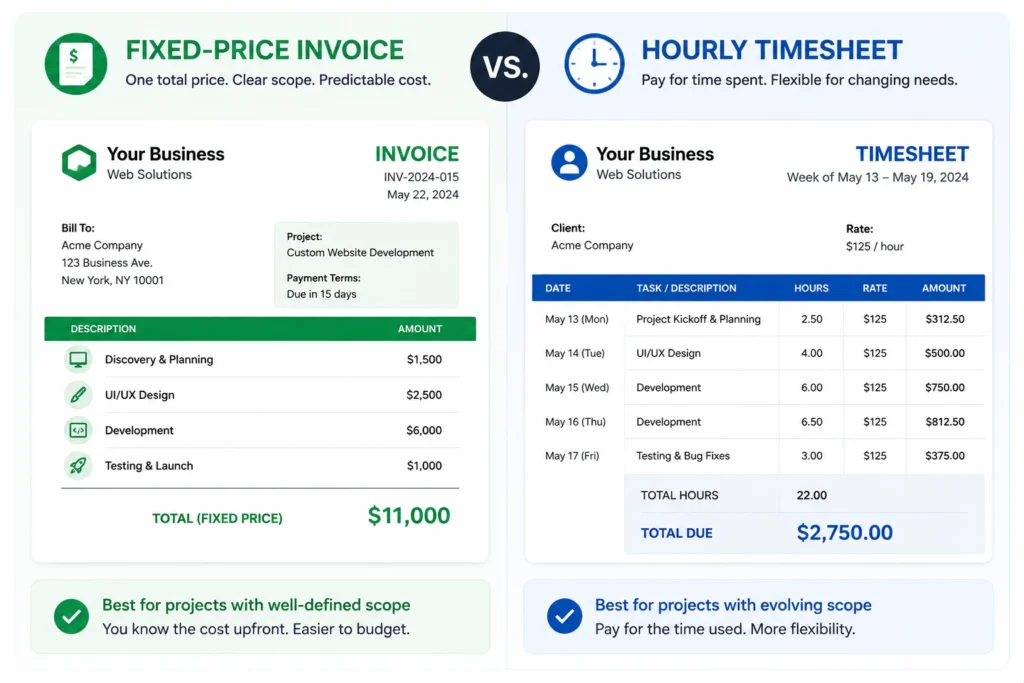
Nearly every quote you’ll receive falls into one of three structures, each with a different risk profile for you as the buyer.
- Hourly billing. You pay for time worked, tracked and invoiced, usually weekly or biweekly.
- Fixed-price billing. You pay one agreed total for a clearly defined scope, regardless of how long it actually takes.
- Value-based pricing. You pay a fee tied to the project’s expected business impact, not the hours or deliverables directly.
Which one you’re offered often depends on how well-defined your project is and how experienced the person quoting it happens to be.
Fixed vs Hourly Web Design: Which One Actually Protects You
The honest answer is that it depends on who’s protected from what. Hourly billing protects the developer from underestimating a messy or unclear project. Fixed pricing protects you from paying more just because the work took longer than expected.
Hourly billing makes sense for genuinely open-ended work, like fixing bugs in a five-year-old custom codebase nobody has fully documented. Quoting a fixed price on unknown legacy work is risky for the person doing the quoting, and that risk usually gets passed back to you through padding.
Fixed pricing works best once scope is clearly defined, such as converting an approved design into a five-page site. At that point, a fixed quote shifts the risk of a slow week onto the developer instead of you, which is exactly why experienced freelancers prefer it for well-defined projects. website design project scoping guide
Value-Based Pricing Web Design: How It Actually Works
Value-based pricing skips hours and deliverables entirely and prices the project against what it’s actually worth to your business. If a new site is expected to generate real revenue, the fee reflects a share of that expected value rather than time spent building it.
In practice, this often looks like quoting 7 to 12% of a project’s expected annual revenue contribution, rather than an hourly estimate. A site projected to drive $200,000 in annual revenue might be quoted at $15,000 to $25,000 under this model, a framing built around outcomes rather than labor.
This model requires real discovery work upfront, since the freelancer or agency needs to understand your business goals well enough to price against them accurately. It’s most common for high-impact projects like conversion-focused landing pages or full e-commerce builds, not simple brochure sites. value-based web design proposal request
Web Design Cost Comparison: What Each Model Actually Costs in 2026
Real numbers make this easier to evaluate than abstract pricing theory.
| Pricing Model | Typical Range | Best For |
|---|---|---|
| Hourly | $40 to $180+/hour, depending on experience | Open-ended work, maintenance, and legacy system fixes |
| Fixed Price (Brochure Site) | $500 to $2,500 | Simple 5 to 10-page websites with a clearly defined scope |
| Fixed Price (Custom Business Site) | $5,000 to $20,000 | Custom website design and development projects |
| Fixed Price (E-commerce or Web App) | $10,000 to $30,000 | Complex websites with advanced functionality and integrations |
| Value-Based | 7% to 12% of projected annual value | High-impact projects tied to measurable business ROI |
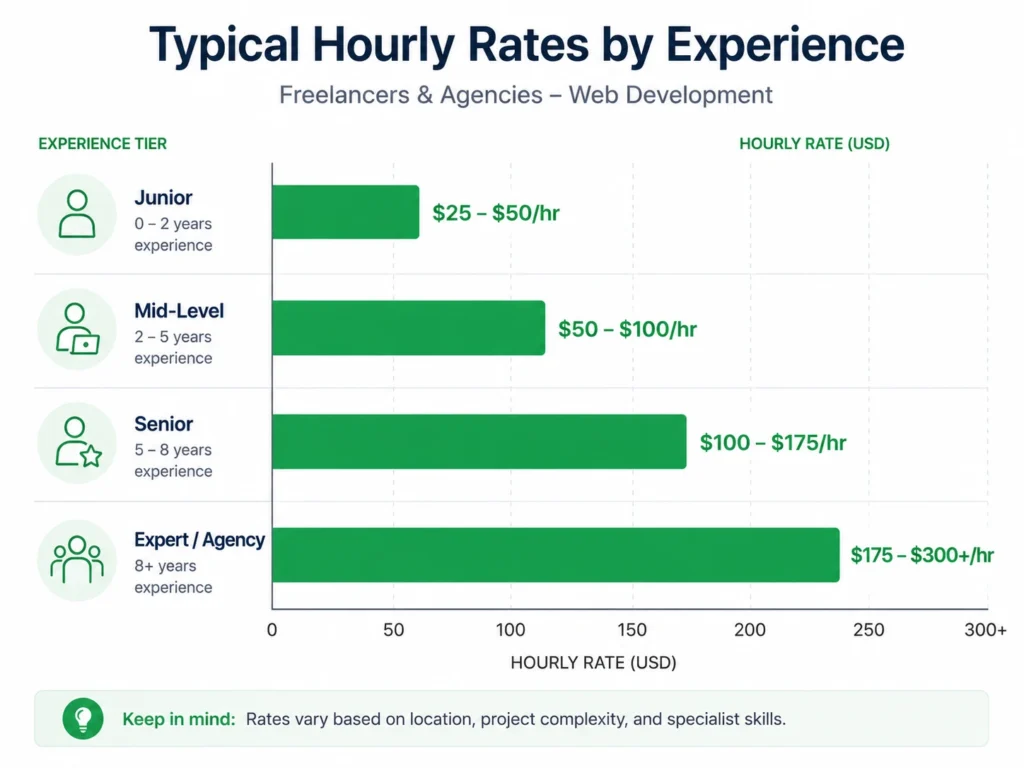
Crowdsourced rate data puts the US freelance web developer average at $70 an hour, with most falling between $40 and $84, based on 494 verified submissions. The top 10% of freelancers report $125 an hour or more, usually reflecting deep specialization or senior experience. get a fixed-price website quote
Freelance Web Developer Rates: What Drives the Range
Rate spread of nearly 4x for the same general skill set comes down to a few consistent factors.
- Experience tier. Junior developers doing template work run $25 to $50 an hour, mid-level developers average around $70 to $85, and senior specialists handling custom functionality charge $90 to $180.
- Platform and vetting. Vetted marketplaces like Toptal or Codeable charge premium rates because they pre-screen talent, while open marketplaces offer wider ranges that require more vetting from you directly.
- Geography. Rates in the US and Western Europe run substantially higher than in South Asia or Eastern Europe for comparable skill levels, though quality isn’t necessarily tied to region.
- Project complexity. Custom functionality and content creation frequently double the base development cost estimate most buyers start with.
How to Price Web Design Services: What to Ask Before You Sign
Whether you’re comparing quotes as a buyer or setting your own rates as a freelancer, the same questions clarify which model actually fits.
- Is the scope fully defined, or genuinely open-ended? Fixed pricing only works when both sides agree on deliverables upfront.
- Does the project have a clear, measurable business outcome? Value-based pricing only makes sense when impact can actually be estimated.
- How much discovery work went into the quote? A confident fixed quote usually means real scoping happened before the number was set.
- What happens if scope changes mid-project? Every model needs a clear answer here, since this is where disputes most often start.
A vague answer to any of these is a stronger warning sign than the price itself.
Frequently Asked Questions
What is value-based pricing in web design?
Value-based pricing charges a fee based on a project’s expected business impact, often a percentage of projected revenue, rather than hours worked or a flat deliverable-based fee.
How to price web design services fairly for both sides?
Match the pricing model to the project. Use hourly billing for open-ended or maintenance work, fixed pricing for clearly scoped projects, and value-based pricing only when the project’s business impact can be reasonably estimated upfront.
Why does fixed price website development often cost more than an hourly estimate?
Fixed pricing typically includes a buffer for unexpected issues, since the developer absorbs the risk of the project running long. That buffer is priced in upfront rather than surfacing as extra hours later.
How to compare freelance web developer rates across different quotes?
Compare experience tier, portfolio quality, and platform vetting alongside the raw hourly number. A senior developer at $150 an hour with proven case studies can be a better value than a junior developer at $40 an hour without one.
What are the risks of hourly web design rates with no estimate?
Open-ended hourly billing with no cap or estimate can lead to scope creep and unpredictable final costs. Always request a not-to-exceed estimate or milestone-based check-ins if hourly billing is unavoidable.
Website design pricing models aren’t just about the number on the quote, they reveal how well the work has actually been scoped. Match the model to your project’s complexity, ask the right questions before signing, and treat a vague answer as a bigger red flag than the price itself.
Ready to get a clear, properly scoped quote instead of guessing which pricing model fits your project? and get pricing built around your actual scope, not a generic rate card.
Related Posts
SSL Certificate and HTTPS: Why They Matter
SSL Certificate and HTTPS: Why They Matter Key Takeaways Starting with Chrome 154 in October 2026, Chrome will...
Read More
webshop
October 21, 2026
Shopify Migration: From WooCommerce or BigCommerce
Shopify Migration: From WooCommerce or BigCommerce Key Takeaways Most WooCommerce stores accumulate 20 to 60 active plugins by the...
Read More
webshop
October 19, 2026
Hidden Costs of Website Development to Watch
Hidden Costs of Website Development to Watch Key Takeaways Scope creep affects roughly half to 70% of software...
Read More
webshop
October 16, 2026