

Custom Website vs Website Builder: Honest Comparison
Key Takeaways
- A website builder costs less upfront ($0 to $300) but limits design, SEO, and scalability as your business grows.
- Custom web design typically runs $3,000 to $25,000+, but gives you full ownership and long-term flexibility.
- 83% of small businesses now have a website, up from 64% in 2018, and most start with a builder before outgrowing it.
- A 3-second load delay can push away roughly 4 in 10 visitors, and design quality shapes trust within milliseconds.
- The right pick depends on your budget, timeline, growth plans, and how much control you need over your brand.
What Small Businesses Really Need to Know
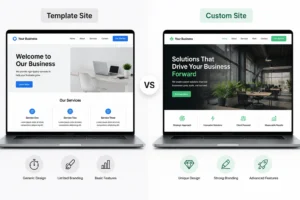
After working with dozens of small business owners on their websites, we keep seeing the same story play out. They start with a website builder to save money, then hit a wall within a year or two. That is the real story behind the custom website vs website builder decision, and it rarely gets told honestly. This guide breaks down real costs, real trade-offs, and the long-term impact of each path. By the end, you will know exactly which option fits your budget and your growth plans. In one sentence: a custom website is built from scratch by a designer or developer to match your exact brand and business goals, while a website builder uses pre-made templates and drag-and-drop tools that launch faster and cost less but offer far less flexibility.
What Is a Website Builder?
A website builder is a drag-and-drop platform like Wix, Squarespace, or GoDaddy. You pick a template, drop in your content, and publish. No coding required. These platforms bundle hosting, security, and basic support into one monthly subscription. That is exactly why they appeal to new startups and solo owners on tight budgets. The simplicity comes at a price, though. You are working inside someone else’s system, with someone else’s rules and limits.
What Is Custom Web Design?
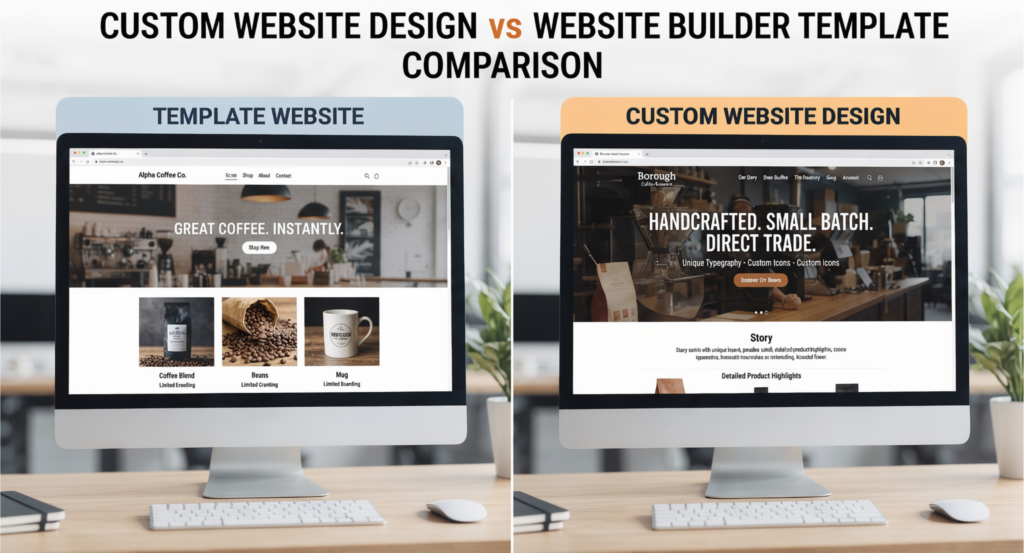
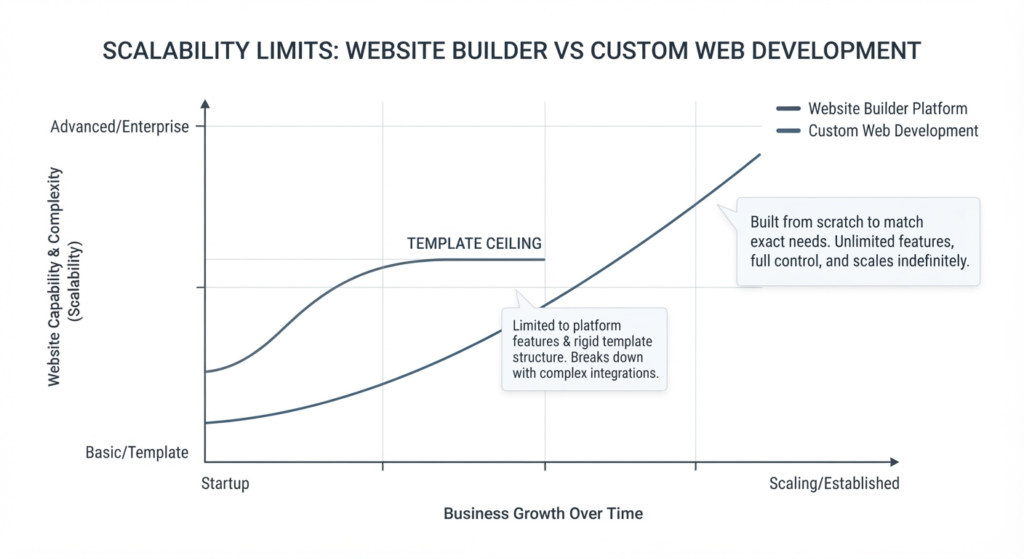
Custom web design means a developer builds your site from the ground up. Every layout, feature, and line of code is created specifically for your business and your users. There is no template ceiling here. If you can describe the feature, a developer can usually build it. Custom sites cost more upfront. In exchange, you get full ownership of your code, design, and data, which a website builder subscription never fully hands over.
Custom Website vs Website Builder: Headto-Head Comparison
Here is a quick side-by-side look at custom website design for small business against a typical website builder for small business.
| Factor | Website Builder | Custom Website |
|---|---|---|
| Upfront cost | $0 to $300 | $3,000 to $25,000+ |
| Monthly cost | $10 to $50 | $50 to $300 (hosting and maintenance) |
| Launch time | 1 to 2 weeks | 4 to 10 weeks |
| Design flexibility | Limited to templates | Unlimited |
| SEO control | Basic built-in tools | Full technical SEO access |
| Scalability | Breaks down with growth | Built to scale |
| Code ownership | Platform owns it | You own it |
| Best for | Startups, MVPs, simple sites | Growing brands, service businesses, ecommerce |
Pros and Cons of Website Builders for Small Business
Where Website Builders Win
• Lower upfront cost, which suits tight startup budgets
• Fast setup, some sites launch within days
• No technical skills required to get started
• Hosting and basic security bundled in
Website Builder Limitations You Should Know
Most builder limitations only show up once your business starts to grow. That is when the trade-offs become expensive.
- Templates look similar across thousands of sites in your same industry
- Limited technical SEO customization, including schema markup and site speed control
- You do not own the website. Cancel the subscription and the site disappears
- Harder to scale as you add booking systems, staff logins, or multiple locations
- Page speed often underperforms. A 3-second load delay can push away close to 40% of visitors
Custom Website Cost: What to Actually Expect
Custom website cost varies a lot depending on scope. Here is a realistic breakdown for 2026
- Freelance designer: $500 to $5,000, good for a simple, semi custom site
- Small agency: $3,000 to $15,000, includes strategy, custom design, and basic SEO
- Full custom build: $15,000 to $50,000+, for complex features , ecommerce, or multi-location businesses
- Ongoing maintenance: $50 to $300 per month for hosting, updates, and support
Is a custom website worth it at that price? For service businesses competing on trust and first impressions, usually yes. Design quality shapes credibility within milliseconds of a visitor landing on your page.
Wix vs Custom Website and Squarespace vs Custom Website
Wix vs Custom Website
Wix holds a large share of the DIY builder market, and it is popular for good reason. It is easy to use and cheap to start. But Wix sites run on Wix’s proprietary system, which limits migration, advanced integrations, and deep customization down the road.
Squarespace vs Custom Website
Squarespace is known for polished, design-forward templates, which makes it popular with creative and service-based businesses. It is still template-based underneath, though. Unique booking flows, custom integrations, or complex site architecture often hit a wall.
Custom Website vs Template: What Is the
Real Difference?
A template is a pre-built structure you fill in with your own content. A custom website vs template comparison usually comes down to one thing: control. Templates prioritize speed and convenience. Custom builds prioritize
your specific business goals, user experience, and brand identity, with nothing borrowed from a shared design library.
Should You Hire a Web Designer or Use a
Website Builder?
The hire a web designer or use a website builder question comes down
to four honest checkpoints:
- Tiny budget, simple needs: a website builder is the practical starting point
- You need lead generation, ecommerce, or industry-specific features: custom web development services make more sense
- You plan to scale, hire staff, or expand locations: custom gives you room to grow
- You want a look competitors cannot copy overnight: custom is the only real option exclusions. Agree how you will measure success and when you will review it.
For many small businesses, the smart move is starting lean and switching to custom web development services once the business outgrows a template. Pairing that move with small business SEO services and a solid WordPress development services foundation sets you up to scale without another rebuild in two
years
Frequently Asked Questions
What is the difference between a custom website and a website builder?
A custom website is coded and designed specifically for your business by a developer. A website builder uses shared templates and drag-and-drop tools on a platform you do not own or control.
How much does a custom website cost for a small business?
Most small businesses pay between $3,000 and $25,000 for a professional custom website, depending on the number of pages, features, and design complexity involved.
Why do website builders have limitations for growing businesses?
Website builders cap what you can build because you are working inside someone else’s platform. As you add features, traffic, or complexity, template systems slow down, limit SEO control, and become harder to scale.
How do I decide whether to hire a web designer or use a website builder?
Base the decision on budget, timeline, and growth plans. Simple sites with tight budgets suit builders. Businesses that need
custom features, stronger SEO, or long- erm scalability usually do better hiring a designer.
Is a custom website worth it for a small business?
For most servicebased businesses and growing brands, yes. The higher upfront cost buys better performance, stronger SEO control, and a design that reflects your business instead of a shared template.
Conclusion
The custom website vs website builder decision is not about which option is “better” in general. It is about which option fits where your business stands right now. Builders work well for a fast, low-cost launch. Custom sites work better once you need real SEO control, unique branding, and room to scale. Many small businesses eventually move from one to the other, and that is a normal part of growing. If you are weighing your options, talk to a team that builds both. Reach out to getwebix for a free consultation and an honest recommendation based on your actual business needs, not a one-size-fits-all pitch
Related Posts
Website Design Pricing Models: Fixed vs Hourly
How to Choose the Right E-commerce Platform Key Takeaways WooCommerce powers the most stores by raw count, roughly...
Read More
webshop
August 4, 2026

How to Choose the Right E-commerce Platform
How to Choose the Right E-commerce Platform Key Takeaways WooCommerce powers the most stores by raw count, roughly...
Read More
webshop
August 3, 2026
Custom Business Website: 10 Signs You Need One
Custom Business Website: 10 Signs You Need One Key Takeaways Builder-powered sites median a mobile PageSpeed score of...
Read More
webshop
July 31, 2026