

How to Choose the Right E-commerce Platform
Key Takeaways
WooCommerce powers the most stores by raw count, roughly 33 to 39% of all e-commerce sites, while Shopify leads among the highest-traffic stores at 28.8%, according to BuiltWith and StoreLeads data.
Shopify’s plans typically run $29 to $299 a month, all-inclusive. WooCommerce is free but needs hosting, plugins, and often developer time, usually $100 to $2,000+ a year depending on scale.
The global e-commerce platform market is projected to reach $13.92 billion in 2026, growing toward $61.83 billion by 2034.
Neither platform is objectively better. The right choice depends on your technical resources, budget structure, and growth trajectory, not market share rankings.
The biggest mistake small businesses make is choosing based on price alone instead of matching the platform to their actual catalog size and growth plans.
In one sentence: to choose the right e-commerce platform, match your technical resources and growth plans to the platform’s strengths, Shopify for managed simplicity, WooCommerce for control and lower long-term cost, rather than picking based on price or popularity alone.
How to Choose the Right E-commerce Platform Without Guessing
I’ve watched businesses launch on the cheapest platform available, only to rebuild eighteen months later once their catalog outgrew it. The mistake wasn’t the platform itself. It was picking based on launch cost instead of where the business was actually headed.
To choose the right e-commerce platform, you need to weigh technical resources, budget structure, and growth plans against what each platform is genuinely built for. This guide breaks down the real differences between the major options, with actual data instead of marketing claims, so you can make this decision once instead of twice.
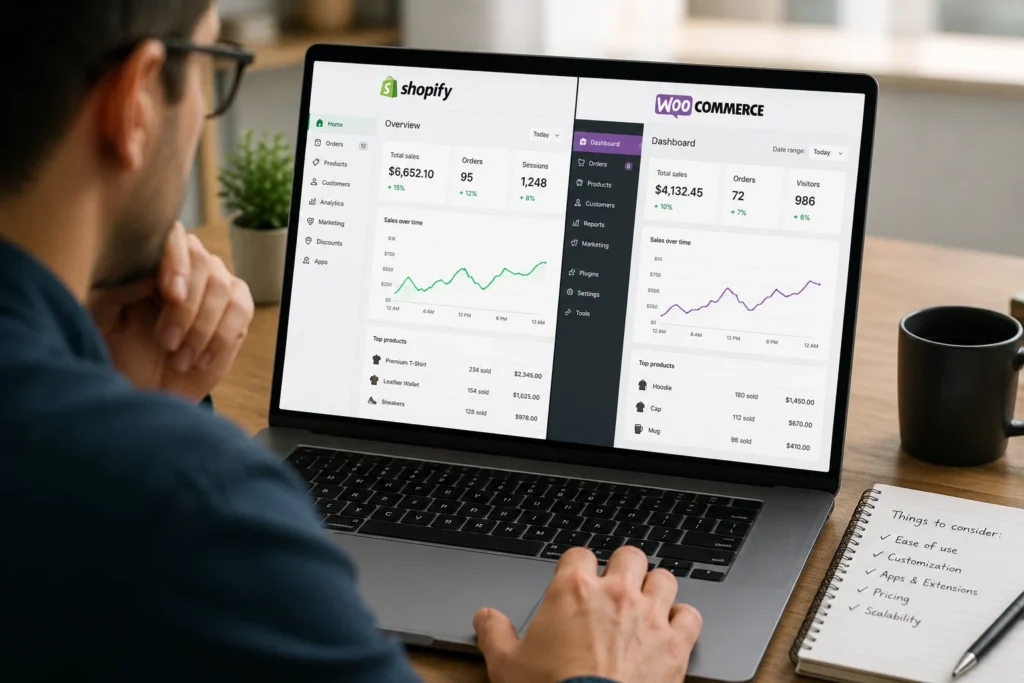
Choosing an E-commerce Platform: Shopify vs WooCommerce Comparison
These two platforms dominate the conversation for a reason, but the “winner” depends entirely on what you’re measuring. Market share figures vary significantly by source because trackers like BuiltWith, StoreLeads, and W3Techs measure different things: total installs, active checkouts, or top-traffic sites only.
By raw store count, WooCommerce leads with roughly 33 to 39% of all e-commerce sites globally. Among the highest-traffic stores specifically, Shopify pulls ahead at 28.8% compared to WooCommerce’s 18.2%. In plain terms, WooCommerce has more stores overall, while Shopify tends to host the bigger, higher-revenue ones.
| Factor | Shopify | WooCommerce |
|---|---|---|
| Starting Cost | $29 to $299/month, all-inclusive | Free plugin, $100 to $600/year for hosting and plugins |
| Setup Complexity | Low, fully managed platform | Moderate to high, requires WordPress familiarity |
| Customization | Good, through Shopify's app ecosystem | Excellent, fully open-source and highly flexible |
| SEO Control | Strong SEO features, but URL structure is fixed | Greater long-term SEO flexibility and control |
| Best For | Businesses wanting a fast launch with minimal maintenance | Content-rich, WordPress-based stores needing maximum flexibility |
Shopify trades some flexibility for convenience and predictable costs. WooCommerce trades convenience for control and lower costs at scale, provided you have the technical resources to maintain it. Shopify vs WooCommerce full breakdown
Best E-commerce Platform for Small Business: Matching Platform to Stage
The right answer changes as your business grows, which is exactly why so many stores eventually migrate.
- Just starting out, under 50 products. A hosted builder like Shopify or a simpler e-commerce website builder gets you selling fastest, with the lowest setup burden.
- Established with steady traffic, 50 to 500 products. This is where WooCommerce’s lower ongoing cost or Shopify’s growing plans both become viable, depending on your team’s technical comfort.
- Scaling past $500K in annual revenue. Cost structures diverge sharply here. WooCommerce stores at this scale can save $6,000 to $13,600 a year compared to equivalent Shopify plans, though that savings assumes you have developer support to maintain it.
There’s no universal right answer at any stage, only the option that fits your current resources and near-term growth plan.
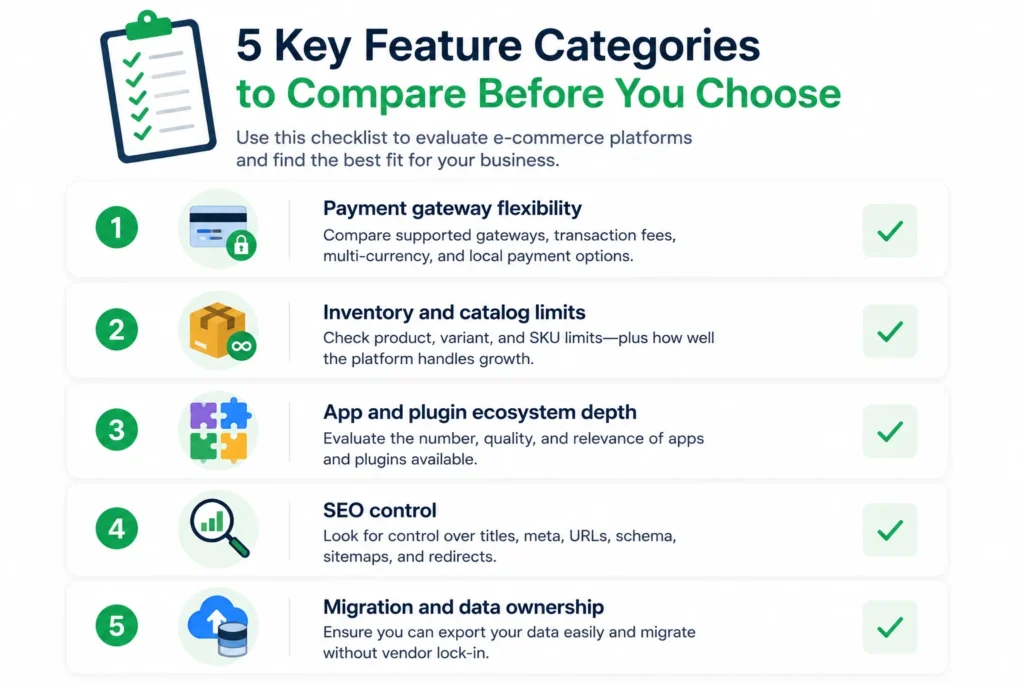
E-commerce Platform Features You Actually Need to Compare
Feature checklists from vendor marketing pages rarely highlight what actually matters day to day. Focus your comparison on these instead.
- Payment gateway flexibility. Confirm the platform supports your preferred processor without forcing you into higher fees on third-party gateways.
- Inventory and catalog limits. Some builders cap product counts or variants at a level growing catalogs outgrow quickly.
- App and plugin ecosystem depth. A thin app library means custom development for features that should be plug-and-play.
- SEO control. Confirm you can edit URL structure, meta tags, and schema markup without fighting the platform’s defaults.
- Migration and data ownership. Understand exactly what happens to your product data and customer records if you ever switch platforms.
Scalable E-commerce Platform: Planning for Growth, Not Just Launch
A platform that works beautifully at launch can become a bottleneck within two years. Building for scale means asking different questions than “what’s cheapest right now.”
Check how each platform handles growth in three specific areas: catalog size limits, checkout customization as your funnel matures, and the cost curve as monthly revenue climbs. WooCommerce’s total cost of ownership scales with complexity and developer time, while Shopify’s cost scales more predictably but less flexibly. Neither curve is wrong, but picking without understanding your own curve is how businesses end up rebuilding sooner than they should. ecommerce scalability assessment
E-commerce Website Builder vs Custom E-commerce Development
Not every business needs the same starting point. Here’s how the two ends of the spectrum compare.
An e-commerce website builder like Shopify, BigCommerce, or Squarespace Commerce gets a store live in days, with hosting, security, and PCI compliance handled for you. This is the right starting point for most small businesses without an in-house technical team.
Custom e-commerce development, whether on WooCommerce with heavy customization or a fully custom build, makes sense once your business needs functionality no off-the-shelf platform supports well. This includes complex B2B pricing rules, highly specific fulfillment logic, or integrations with legacy internal systems. custom ecommerce development services
How to Select an E-commerce Platform: A Step-by-Step Framework
A structured evaluation beats comparing feature lists in isolation.
- List your must-have features first, separate from nice-to-haves, based on your actual product and fulfillment needs.
- Estimate your realistic year-one and year-three revenue, since cost structures diverge sharply as volume grows.
- Honestly assess your technical resources, whether that’s in-house, a freelancer, or an agency you’ll rely on for maintenance.
- Request a real cost breakdown from each platform, including apps, transaction fees, and hosting, not just the headline plan price.
- Check migration difficulty before committing, so switching later isn’t harder than it needs to be.
- Trial the admin experience directly, since day-to-day usability affects how efficiently you’ll actually run the store.
Skipping step 2 is the most common reason small businesses pick a platform that fits today but not eighteen months from now.
Skipping step 2 is the most common reason small businesses pick a platform that fits today but not eighteen months from now.
Frequently Asked Questions
What is the best e-commerce platform for a small business?
There isn’t a single best platform for every small business. Shopify suits businesses wanting a fast, low-maintenance launch, while WooCommerce suits businesses already using WordPress or wanting more control and lower long-term costs.
How to choose the right e-commerce platform for a growing catalog?
Estimate your product count and revenue over the next two to three years, then check each platform’s catalog limits, app ecosystem depth, and cost curve at that scale before committing, not just at launch-day pricing.
Why does Shopify vs WooCommerce come down to more than price?
Shopify bundles hosting, security, and compliance into one predictable fee, trading some flexibility for convenience. WooCommerce is cheaper at the plugin level but requires hosting, maintenance, and often developer time, which shifts the real cost elsewhere.
How to select an e-commerce platform without overpaying for features you won't use?
List your actual must-have features before comparing platforms, request a full cost breakdown including apps and transaction fees, and avoid paying for enterprise-level scalability your current catalog and traffic don’t yet require.
What are the signs a business needs custom e-commerce development instead of a builder?
Signs include complex B2B pricing rules, fulfillment logic no plugin supports, or the need to integrate with legacy internal systems that a standard builder’s app ecosystem can’t handle well.
To choose the right e-commerce platform, match the decision to your actual technical resources and growth plan, not the lowest sticker price or the platform your competitor happens to use. The right fit today should still make sense in three years, not just on launch day.
Ready to figure out which platform actually fits your business? And get a plan built around your catalog and growth stage, not a generic comparison chart.
Related Posts
Custom Ecommerce Development vs SaaS: Compared
Custom Ecommerce Development vs SaaS: Compared Key Takeaways SaaS ecommerce platforms launch fast and cost little upfront, but...
Read More
webshop
September 26, 2026
Custom Website vs Website Builder: Honest Comparison
Custom Website vs Website Builder: Honest Comparison Key Takeaways A website builder costs less upfront ($0 to $300)...
Read More
webshop
September 21, 2026

E-commerce Shipping and Tax Automation
E-commerce Shipping and Tax Automation Key Takeaways Shipping charges are taxable in more than half of US states,...
Read More
webshop
August 15, 2026