
Custom Ecommerce Development vs SaaS: Compared
Key Takeaways
- SaaS ecommerce platforms launch fast and cost little upfront, but fees compound as revenue grows, since most charge a
percentage of every sale. - Custom ecommerce development typically costs $15,000 to $70,000+ for small-to-mid businesses, with full ownership of code and data in return.
- Headless commerce, a hybrid approach, is growing at over 20% annually, but it usually makes sense only once a SaaS platform starts holding you back.
- The right choice depends on order volume, growth plans, and how much you need the platform to do things a template cannot.
- Most businesses do not need to choose once and for all. Many start on SaaS and migrate to custom once the numbers justify it.
Custom Ecommerce Development vs SaaS: Compared
Every growing online store eventually asks the same question. Custom ecommerce development vs SaaS platforms like Shopify or BigCommerce, which one actually fits the business? We have migrated stores off SaaS platforms the moment transaction fees and app costs started outpacing what a custom build would have cost. We have also talked founders out of custom builds they did not need yet. Both calls come from the same math. This guide breaks down the real trade-offs, actual costs, and a simple framework for deciding which path fits your stage of growth. In one sentence: custom ecommerce development means building your own platform and owning the code, while SaaS ecommerce platforms rent you a ready-made system with less control but a much faster launch. What Is the Difference Between Custom Ecommerce Development and SaaS? SaaS ecommerce platforms, think Shopify, BigCommerce, or Wix, bundle hosting, security, and a store builder into one subscription. You rent the infrastructure and follow its rules. Custom ecommerce website development means a team builds your storefront, checkout, and backend from scratch, or heavily customizes an open-source base like WooCommerce or Magento. You own every part of it. Neither option is universally better. The right pick depends on your catalog size, growth trajectory, and how unique your buying process
needs to be.
Custom Ecommerce Development vs SaaS:
Head-to-Head Comparison Here is a quick side-by-side for anyone weighing custom ecommerce vs Shopify or a similar SaaS platform.
| Factor | SaaS Ecommerce Platform | Custom Ecommerce Development |
|---|---|---|
| Upfront cost | $0 to $2,000 | $15,000 to $100,000+ |
| Ongoing fees | Monthly subscription + 2-3% per transaction | Hosting and maintenance only |
| Launch time | Days to a few weeks | 2 to 7 months |
| Design flexibility | Limited to themes and apps | Unlimited |
| Scalability | Can hit plan and app limits | Built for your exact growth path |
| Code ownership | Platform owns it | You own it |
| Best for | New stores, testing an idea | Established brands with specific needs |
Pros and Cons of SaaS Ecommerce Platforms
SaaS ecommerce platforms exist because they solve a real problem: speed. Here is where they genuinely win
- Live in days, sometimes hours, with no developer required
- Hosting, security, and PCI compliance handled for you
- A large app marketplace covers most common features
- Predictable monthly cost at low order volumes
The trade-offs show up as the business grows.
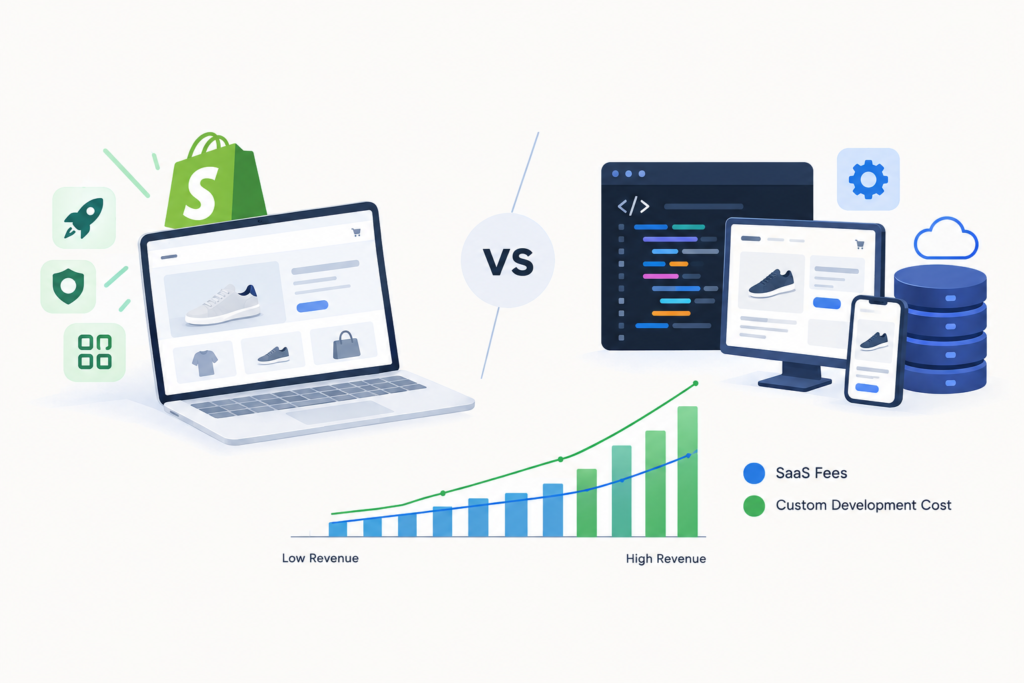
- Transaction fees scale with revenue. A store doing $1 million a year in sales can pay tens of thousands in fees alone
- Design and checkout customization hit hard limits
- Heavy reliance on third-party apps can slow page speed
Migrating off the platform later means rebuilding, not just moving files
Custom Ecommerce Development Cost: What to Expect
Custom ecommerce development cost depends on scope, but small and mid-sized businesses generally see three realistic tiers.
- Basic custom build: $15,000 to $30,000, covers a custom
storefront on an open-source base with core features - Mid-complexity build: $30,000 to $70,000, adds custom
checkout flows, integrations, and unique product logic - Advanced or headless build: $70,000 to $150,000+, built for
scale, multiple channels, or complex catalogs
Compared to Shopify vs custom website math, SaaS wins on upfront cost every time. Custom usually wins on total cost once a store crosses roughly $500,000 to $1 million in annual revenue, where transaction fees and app subscriptions start adding up fast.
Headless Commerce: The Middle Ground Worth Knowing
Headless commerce separates the frontend customer experience from the backend system, connecting the two through APIs. It gives you SaaS-level backend reliability with custom-level frontend freedom. The headless commerce market is growing more than 20% a year as more scaling brands adopt it. That said, it rarely makes sense for a brand-new small business. It shines once a company has outgrown a template but is not ready for a fully custom build from the ground up.
Build vs Buy: How to Decide for Your Business
The build vs buy ecommerce platform decision comes down to four honest questions.
1. Are you validating a new product or market? Start with a SaaS platform, speed matters more than flexibility right now
2. Are transaction fees eating into margin as you scale? Custom development usually pays for itself past a certain revenue point
3. Do you need a checkout flow, integration, or feature a template cannot support? That is a strong signal for custom
4. Is your team ready to manage code and maintenance, or would you rather a platform handle it? Be honest about internal
capacity
For most new startups, the best ecommerce platform for small business is still a SaaS platform, at least at first. Scalable ecommerce solutions become worth the investment once growth, not launch speed, is the priority.
Frequently Asked Questions
What is the difference between custom ecommerce development and SaaS?
Custom ecommerce development means building and
owning your platform outright. SaaS ecommerce platforms like Shopify
rent you a ready-made system with a monthly fee and less control over
code and design.
How much does custom ecommerce development cost?
Small to
mid-sized businesses typically pay between $15,000 and $70,000 for a
custom ecommerce build, depending on features, integrations, and
design complexity.
Why does custom ecommerce vs Shopify matter for growing stores?
As sales volume grows, Shopify’s percentage-based
transaction fees and app subscriptions compound. Custom development
trades a higher upfront cost for lower long-term fees and full ownership.
How do I decide between build vs buy for my ecommerce platform?
Start with a SaaS platform if you are validating an idea or launching fast.
Move toward custom development once transaction fees, feature limits,
or design constraints start costing you sales.
Is headless commerce worth it for a small business?
Usually not at
launch. Headless commerce fits businesses that have outgrown a
standard SaaS platform and need more flexibility across channels, not
brand-new stores still finding product-market fit.
Custom ecommerce development vs SaaS is not a one-time decision. It is a question worth revisiting as your store grows.
Start fast and lean if you are early. Move toward a custom or headless build once the platform itself starts limiting growth instead of supporting it. Reach out to getwebix for an honest assessment of where your store stands and what actually makes sense at your stage.
Related Posts
