

Restaurant Website Design: Menus, Reservations, Delivery
Key Takeaways
- About 86% of diners check a restaurant’s website before decidingwhere to eat, which makes the site a bigger sales driver than most owners realize.
- Roughly 67% to 71% of customers prefer ordering directly from a restaurant’s own site over a third-party delivery app.
- Direct orders typically run about 35% higher per transaction than orders placed through third-party platforms.
- Restaurant website cost ranges from around $1,000 for a simplesite to $10,000 or more for a fully custom build with ordering andreservations.
- Mobile experience, menu clarity, and a completed GoogleBusiness Profile matter more to conversions than flashy design.
Restaurant Website Design: Menus,Reservations, and Delivery
Roughly 86% of diners check a restaurant’s website before deciding where to eat. That single stat should change how any owner thinks about restaurant website design, since the site is doing real sales work before a customer ever calls or walks in. We have rebuilt restaurant sites that looked fine but buried the menu three clicks deep, or made reservations impossible on a phone. Fixing those two things alone often moved the needle more than a full visual redesign. This guide covers what actually matters: menus, reservations, ordering, and the mobile experience that ties it all together. In one sentence: good restaurant website design puts an easy-to-read menu, a simple reservation flow, and direct online ordering all within a tap or two on a phone, since that is how most diners actually decide where to eat.What Makes Restaurant Website Design Different?
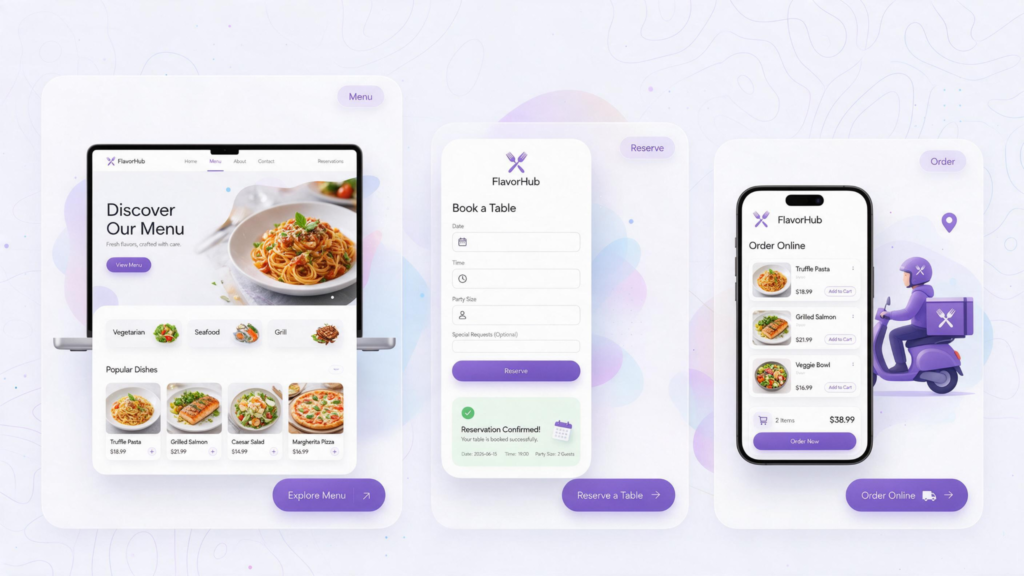
Restaurant website features are not the same as a typical service business site. Diners want to answer three questions fast: what is on the menu, can I book a table, and can I order food right now. Strong restaurant website examples share a few common traits.- The menu is visible from the homepage, not buried in a PDF download
- Hours, location, and phone number are impossible to miss
- Reservations and ordering are one click away, not hidden in a dropdown
- Real photos of food and the space, not generic stock images
Online Menu Design for Restaurants
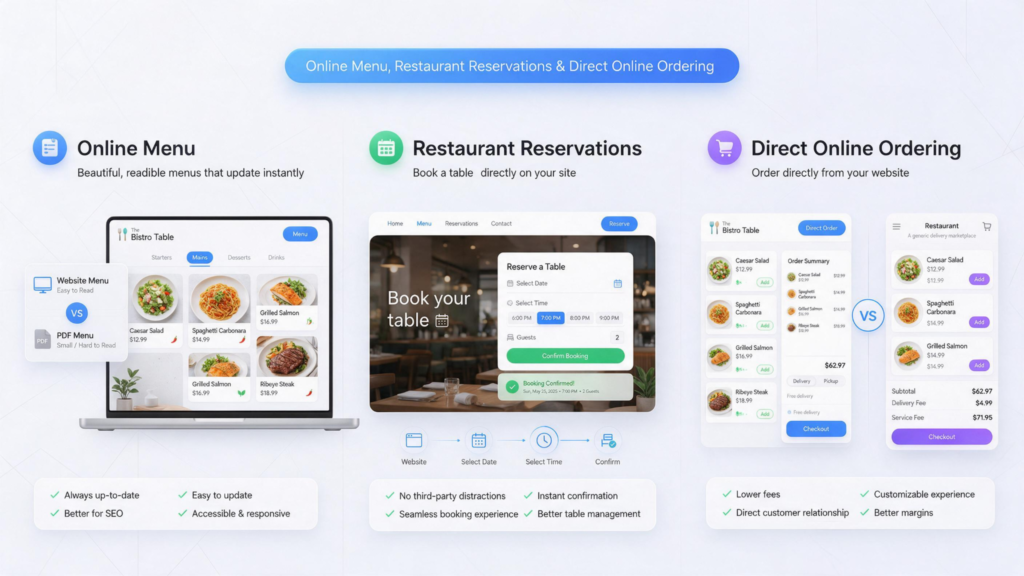
Online menu design for restaurants should never rely on a static PDF. PDFs load slowly on mobile, resist updates, and are painful to read on a small screen. Build the menu directly into the website as readable text, organized by category, with prices and dietary tags clearly marked. This also lets Google index your actual menu items, which helps with search visibility for specific dishes. Update the menu the moment prices or items change. An outdated menu online creates a bad first impression before a customer even arrives.
Restaurant Reservation System Integration
Restaurant reservation system integration turns a nice-to-have into a real booking channel. Embed a live booking widget directly on the site instead of linking out to a separate reservation page. Popular options like OpenTable, Resy, and Tock all offer embeddable widgets that keep the customer on your site through the entire booking flow. Fewer steps and fewer redirects mean fewer abandoned bookings.
Online Ordering and Food Delivery Integration for Restaurant Websites
An online ordering system for restaurants pays for itself quickly once you account for third-party commission fees. Roughly 67% to 71% of customers say they prefer ordering directly from a restaurant’s own site or app over a delivery marketplace. That preference has a real dollar value attached. Direct orders typically run about 35% higher per transaction than orders placed through thirdparty apps, since restaurants control the pricing and upsell flow. Food delivery integration for restaurant websites works best through a direct ordering platform embedded on your site, with third-party apps used as a secondary channel rather than the primary one.
Mobile-Friendly Restaurant Website and Local SEO
A mobile-friendly restaurant website is not optional. Most diners search for a place to eat while already out, on their phone, often within minutes of deciding they are hungry. Menus, reservation buttons, and click-to-call phone numbers all need to work cleanly on a small screen without pinching or zooming.
Local SEO and Google Business Profile for Restaurants
Local SEO for restaurants often matters more than general SEO, since most searches are location-based. Nearly half of all Google searches carry local intent, which puts restaurants squarely in that pattern. Claim and fully complete your Google Business Profile for restaurants, including hours, menu links, and recent photos. A complete profile is one of the simplest ways to win the “restaurants near me” search moment.
Restaurant Website Builder vs Custom Design: Which Fits Your Business?
A restaurant website builder vs custom design decision usually comes down to how much the site needs to do beyond looking good.
- Website builder (Wix, Squarespace): works fine for a simple site with a static menu and basic contact info
- Custom design: worth it once you need embedded reservations, direct ordering, and menu items that update on their own
Most independent restaurants outgrow a builder the moment they add online ordering, since builder-based ordering tools often carry their own commission fees layered on top of the platform cost.
Restaurant Web Design Cost: What to Expect
Restaurant web design cost varies with how much functionality the site needs to handle.
| Site Type | Typical Cost | What's Included |
|---|---|---|
| DIY builder | $16 to $50 per month | Basic pages, static menu, contact info |
| Simple custom site | $1,000 to $3,000 | Homepage, menu, hours, location, contact |
| Full custom build | $3,000 to $10,000+ | Reservations, direct ordering, photo galleries, local SEO setup |
Budget the extra investment toward ordering and reservations first. These two features tend to pay for themselves the fastest.
Frequently Asked Questions
What should be included in restaurant website design?
A restaurant
website should include a readable online menu, embedded reservations,
direct ordering, mobile-friendly navigation, and a completed Google
Business Profile for local search visibility.
How much does restaurant website design cost?
Restaurant website
design typically costs between $1,000 for a simple site and $10,000 or
more for a full custom build with reservations and online ordering built in.
Why does online menu design matter for restaurant SEO?
A PDF
menu cannot be indexed easily by Google, while a menu built directly
into the site can be found by name for specific dishes, which brings in
searches you would otherwise miss.
How do I choose between a restaurant website builder and custom design?
A website builder works for a simple, static site. Custom design
becomes worth it once you need embedded reservations, direct online
ordering, and menu updates without commission fees layered on top.
Why is mobile-friendly design so important for restaurant websites?
Most diners search for restaurants on their phones, often
while already deciding where to eat. A site that is hard to navigate on
mobile loses that customer to a competitor within seconds.
Restaurant website design is not about looking impressive. It is about making the menu, reservations, and ordering effortless on a phone, since that is exactly how most diners decide where to eat. Get those three pieces right, and the design work pays for itself in bookings and orders. Reach out to getwebix for a restaurant website built around how your customers actually order and book.
Related Posts
Local SEO for Service Businesses: Full Guide
Local SEO for Service Businesses: Full Guide Key Takeaways 46% of all Google searches carry local intent, and...
Read More
webshop
October 23, 2026
SSL Certificate and HTTPS: Why They Matter
SSL Certificate and HTTPS: Why They Matter Key Takeaways Starting with Chrome 154 in October 2026, Chrome will...
Read More
webshop
October 21, 2026
Shopify Migration: From WooCommerce or BigCommerce
Shopify Migration: From WooCommerce or BigCommerce Key Takeaways Most WooCommerce stores accumulate 20 to 60 active plugins by the...
Read More
webshop
October 19, 2026