

Travel Website Design: Booking Integration Guide
Key Takeaways
- OTA commissions typically run 15% to 25% per booking, compared to roughly 5% to 12% for the all-in cost of a direct
booking. - Direct bookings generate meaningfully higher revenue per stay than OTA bookings, often by $40 or more once fees are factored
in. - The average hotel website converts at just 1.5% to 2.5%, and mobile conversion drops even lower, around 0.5% to 1.5%.
- Every extra second of booking engine load time can cut conversion by 7% to 10%.
- Strong travel website design pairs a fast, mobile-friendly booking engine with a properly synced channel manager, not just an attractive homepage.
Travel Website Design: Booking IntegrationGuide
OTA commissions typically eat 15% to 25% of every booking, while the all-in cost of a direct booking usually runs closer to 5% to 12%. That gap alone explains why travel website design has become less about looks and more about the booking engine sitting behind it. We have worked with hospitality clients whose sites looked polished but converted worse than their OTA listings. The problem was rarely the design itself. It was a clunky booking flow standing between an interested visitor and a completed reservation. This guide covers what actually drives bookings: engine integration, channel management, and a mobile experience that does not lose guests halfway through checkout.
In one sentence: effective travel website design means pairing a fast,
easy booking engine with real-time availability syncing, since that combination is what actually converts visitors into direct bookings instead of losing them to an OTA.
Why Travel Website Design Depends onBooking Integration
A beautiful travel or hospitality site with a slow, confusing booking flow still loses bookings. Guests do not tolerate friction the way they might on a browsing-only site, since money and travel dates are on the line. Booking integration needs to feel instant and trustworthy. Every extra click, every unclear pricing step, and every slow-loading page pushes a guest back toward the OTA they were trying to avoid.
Direct Bookings vs OTA: Why Your Booking Engine Matters
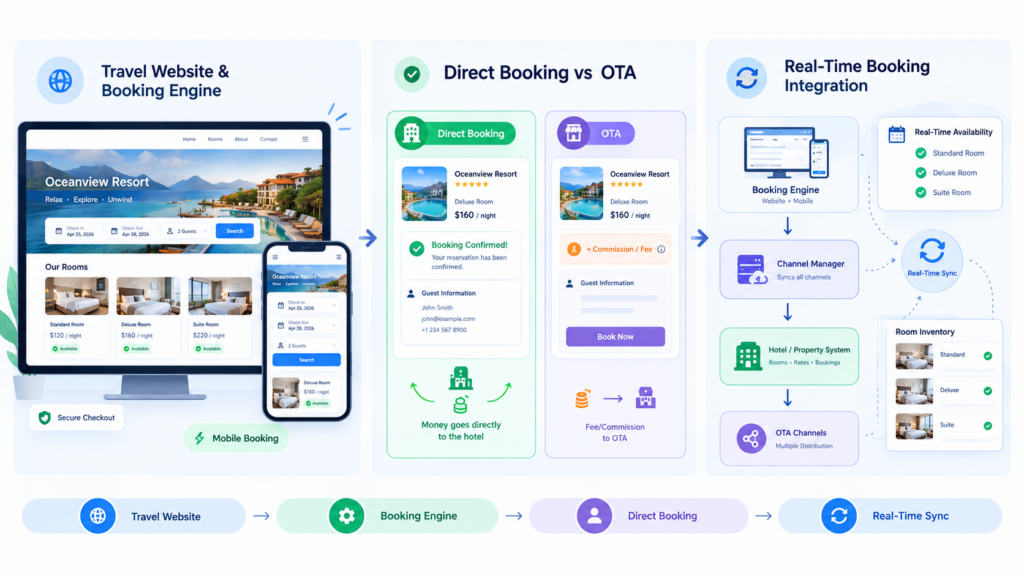
The direct bookings vs OTA debate comes down to margin. OTA commissions commonly land between 15% and 25% per stay, and
effective costs including preferred placement fees can climb even higher. Direct bookings tell a different story. Properties that shift volume toward their own site typically see notably higher revenue per booking, often $40 or more per stay once OTA fees are accounted for, along with better guest data and stronger repeat business. The catch is conversion. The average hotel website converts around 1.5% to 2.5% of visitors, with mobile trailing at just 0.5% to 1.5%. A strong booking engine is what closes that gap.
Booking Engine and Channel Manager Integration for Websites
Choosing a Hotel Booking Engine A hotel booking engine needs to do three things well: load fast, show real-time availability, and complete a booking in as few steps as possible.
Look for a booking engine that:
- Loads in under two seconds, since load time directly affects conversion
- Works cleanly on mobile without pinching or horizontal scrolling
- Shows live rates and availability, not cached or delayed data
- Integrates directly into the site rather than redirecting to an external page
- Supports upsells like room upgrades or add-ons without adding extra steps
Channel Manager Integration
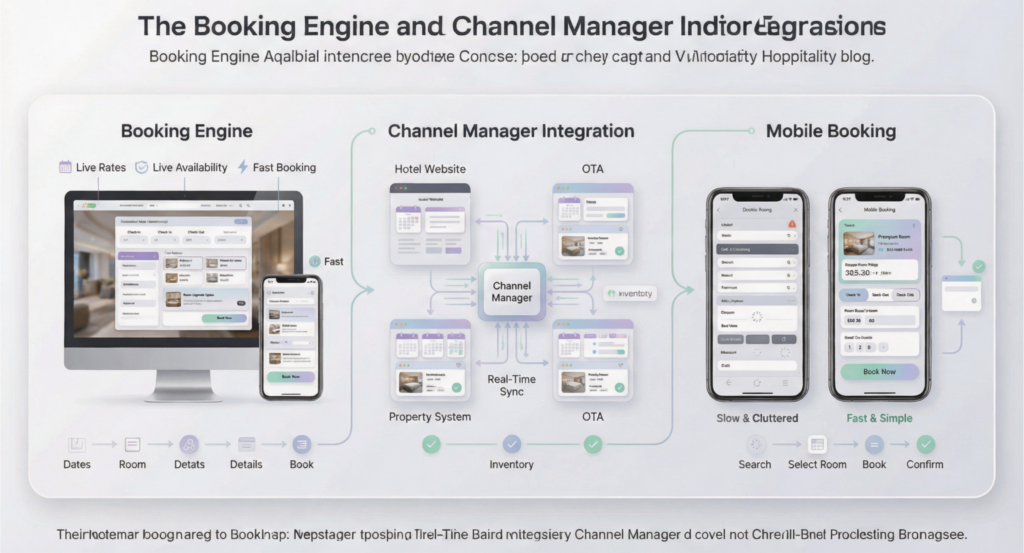
Channel manager integration keeps availability synced across your website, OTAs, and any other distribution channels automatically. Without it, staff must manually update inventory everywhere, which invites overbooking and lost revenue.
A properly connected channel manager updates every channel the moment a booking happens anywhere, on the website or an OTA. This is what makes it safe to compete on your own site without risking double bookings elsewhere.
Hospitality Website Design Across Hotels, Travel Agencies, and Tour Operators
Hotel website design, travel agency website design, and tour operator website design share the same booking-first priority, but the details shift by business type.
| Business Type | Core Booking Need | Design Priority |
|---|---|---|
| Hotels | Room availability and rate booking | Speed, real-time inventory, mobile checkout |
| Travel agencies | Package and itinerary inquiries | Clear packages, easy quote requests |
| Tour operators | Date-based activity booking | Calendar clarity, group size and add-ons |
Regardless of category, the underlying principle stays the same: reduce
the number of steps between interest and a confirmed booking.
Mobile-Friendly Booking Experience and Site Speed
A mobile-friendly booking experience is no longer optional. More than half of OTA bookings now happen on smartphones, and travel and hospitality sites see similarly heavy mobile traffic. Speed compounds this further. Every extra second of booking engine
load time can cut conversion by 7% to 10%, which means a slow mobile checkout is actively costing bookings every single day it stays that way.
Travel Website Design Best Practices: A Quick Checklist
Travel website design best practices come down to a short, repeatable list.
- Keep the booking engine embedded on-site, never a jarring redirect
- Test the full booking flow on mobile every time the site changes
- Sync availability through a channel manager to avoid overbooking
- Show transparent pricing early, not as a surprise at checkout
- Highlight what direct booking offers that OTAs cannot, like perks or flexible policies
Frequently Asked Questions
What is travel website design?
Travel website design is the process of
building a site for hotels, travel agencies, or tour operators that
combines strong visuals with a fast, integrated booking engine, since
bookings, not browsing, are the actual goal.
How does booking engine integration for websites actually work?
A
booking engine embeds directly into the site, pulling live availability and
rates so guests can complete a reservation without leaving the page or
hitting a third-party redirect.
Why do direct bookings matter more than OTA bookings for hotels?
Direct bookings avoid OTA commissions, which typically run
15% to 25% per stay, and generate higher net revenue per booking
along with first-party guest data for future marketing.
What is channel manager integration and why does it matter?
A
channel manager syncs room or activity availability across your website
and every OTA automatically, preventing overbooking and keeping
pricing consistent without manual updates.
How important is a mobile-friendly booking experience?
Very. More
than half of travel bookings now happen on mobile, and every extra
second of load time on a booking engine can cut conversion by up to
10%
Travel website design is not just about first impressions anymore. It is about whether your booking engine can actually convert the visitors your design and marketing bring in. Fast, mobile-first, and properly synced with your channel manager, that
is what turns a nice-looking site into one that wins bookings back from OTAs. Reach out to getwebix for a travel or hospitality website built around your booking engine, not just your homepage.
Related Posts
SSL Certificate and HTTPS: Why They Matter
SSL Certificate and HTTPS: Why They Matter Key Takeaways Starting with Chrome 154 in October 2026, Chrome will...
Read More
webshop
October 21, 2026
Shopify Migration: From WooCommerce or BigCommerce
Shopify Migration: From WooCommerce or BigCommerce Key Takeaways Most WooCommerce stores accumulate 20 to 60 active plugins by the...
Read More
webshop
October 19, 2026
Hidden Costs of Website Development to Watch
Hidden Costs of Website Development to Watch Key Takeaways Scope creep affects roughly half to 70% of software...
Read More
webshop
October 16, 2026