

Conversion-Focused Website Redesign: A Data Guide
Key Takeaways
- De Beers ran a data-driven redesign using heatmaps and journey analysis and saw a 30% conversion lift site-wide, a real,documented case study.
- Only about 12% to 15% of A/B tests actually produce a winning result, so redesigns need a real hypothesis behind every change, not guesswork.
- A/B tests generally need 350 to 1,000+ visitors per variation to reach statistical significance, depending on your baseline conversion rate.
- HubSpot’s analysis of 300,000 pages found that calls-to-action placed above the fold perform 47% better than those placed midpage.
- A conversion-focused website redesign treats design decisions as testable hypotheses, not opinions, from the first wireframe onward.
Conversion-Focused Website Redesign: A Data Guide
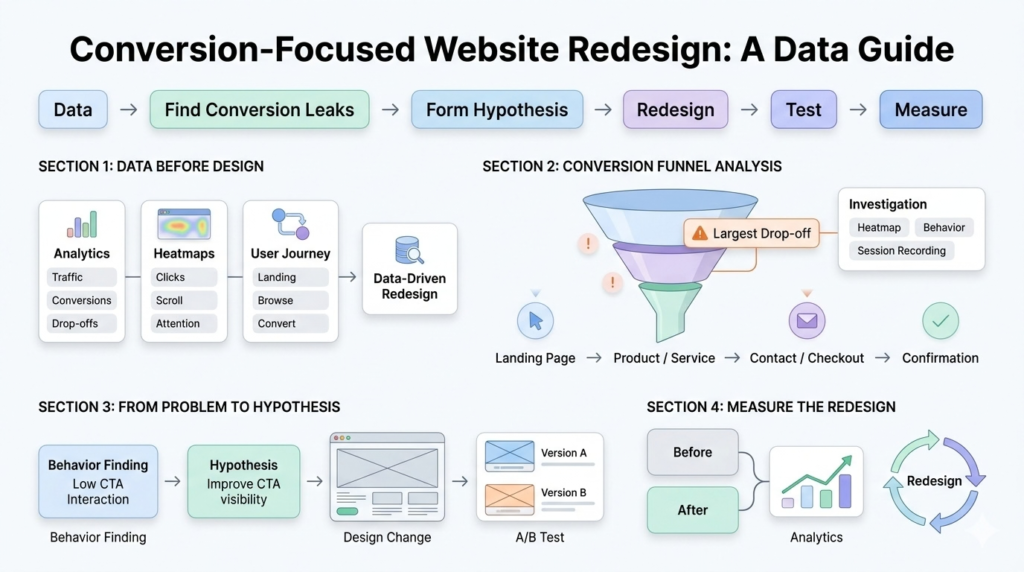
De Beers ran a conversion-focused website redesign built on heatmaps
and customer journey analysis, and saw conversion rates climb 30%
site-wide. That is the difference data makes when a redesign is treated
as a testable hypothesis instead of a fresh coat of paint.
We have seen the opposite happen too often. A business redesigns
based on what looks good to the team internally, launches, and
conversions barely move, or actually drop, because nobody checked
what visitors were actually doing before.
This guide walks through how to redesign with data driving every
decision, from funnel analysis through post-launch measurement.
In one sentence: a conversion-focused website redesign uses funnel
data, heatmaps, and testing to identify exactly where visitors struggle,
then validates every design change against real behavior instead of
internal opinion.
What Makes a Conversion-Focused Website Redesign Different?
A data-driven website redesign starts with evidence, not inspiration.
Before a single wireframe gets drawn, the team should already know
where visitors drop off, what they click, and what they ignore.
Redesigning a website for conversions means every major decision,
layout, copy, navigation, ties back to a specific behavioral finding. A
generic visual refresh might look better. It will not necessarily convert
better, and those are not the same goal.
Conversion Funnel Analysis: Find the Leaks Before You Redesign
Conversion funnel analysis maps the exact path visitors take from landing on your site to completing a goal, and shows precisely where they abandon that path.
Start here, before touching design.
- Define your funnel stages clearly, landing page, product or service page, contact or checkout, confirmation
- Pull drop-off rates for each stage using your existing analytics
- Identify the single stage losing the most visitors relative to its traffic
- Dig into session recordings or heatmaps specifically at that stage
- Form a hypothesis about why visitors are leaving there, then design around fixing it
This turns a redesign from “make it look better” into “fix the specific stage costing us the most conversions.”
| Baseline Conversion Rate | Minimum Visitors per Variant | Typical Test Duration |
|---|---|---|
| 1% | 1,000+ | 4 weeks |
| 3% | 500 | 2 to 3 weeks |
| 5% | 350 | 2 weeks |
| 10%+ | 200 | 2 weeks |
Heatmap Analysis and User Behavior Analytics for Redesign
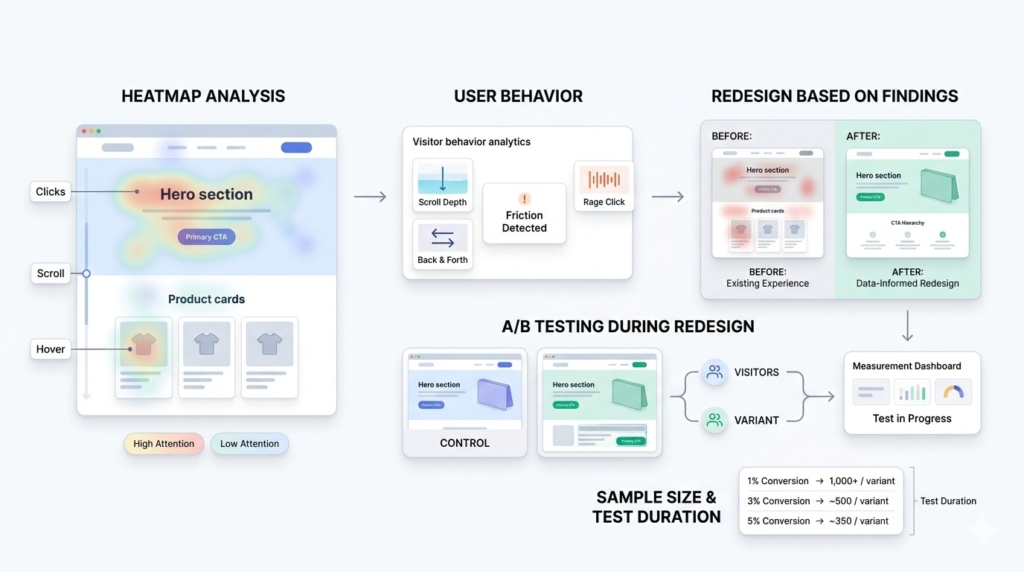
Heatmap analysis for redesign shows exactly where visitors click, scroll, and hover, revealing gaps between what your team assumes matters and what actually gets attention. This is precisely the method behind the De Beers case. Their team used heatmaps and journey analysis to uncover where the existing site’s digital experience fell short of the in-store one, then redesigned specifically around those findings rather than a general brand refresh. User behavior analytics extends this further, tracking scroll depth, rage clicks, and repeated back-and-forth navigation that often signals confusion. A button nobody scrolls far enough to see is a wasted design decision, no matter how well it was designed.
A/B Testing During Website Redesign
A/B testing during website redesign validates whether a specific change actually improves results, rather than assuming it does because it looks better. Here is the honest part most guides skip. Only about 12% to 15% of A/B tests produce a statistically significant winner. That is normal, not a sign something went wrong. It is exactly why testing individual changes, rather than shipping an entire redesign at once, protects you from betting everything on an unvalidated guess. Sample size matters too. Most tests need somewhere between 350 and 1,000 or more visitors per variation to reach statistical significance, depending on your current conversion rate.
Lower-traffic sites may need to test bigger, bolder changes rather than small tweaks, simply to reach a meaningful sample size within a reasonable timeframe.
Website Redesign KPIs: What to Track Before and After
Website redesign KPIs need to be locked in before launch, not decided afterward once someone asks whether the redesign actually worked.
Track at minimum:
- Overall conversion rate, plus conversion rate by traffic source
- Average time on key pages and bounce rate
- Funnel completion rate at each defined stage
- Page load speed, since this affects every other metric
- Revenue or lead value per visitor, not just raw conversion count
How to measure website redesign success comes down to comparing these exact metrics against a documented pre-redesign baseline, ideally over a comparable time period to account for seasonality.
CRO Website Redesign Process: A Simple Framework
A CRO website redesign follows a repeatable sequence rather than a one-time event.
1. Audit current analytics, funnel data, and heatmaps to identify the biggest leaks
- Form specific, testable hypotheses for each identified problem
- Design changes that directly address those hypotheses, not just aesthetic preferences
- Test major changes before or immediately after full launch where traffic allows
- Track redesign KPIs against your baseline for at least 30 to 60 days
- Keep iterating, since conversion rate optimization redesign is ongoing, not a single project
Website redesign to increase conversions works best as this continuous cycle, not a one-time launch you walk away from.
Frequently Asked Questions
What is a conversion-focused website redesign?
A conversionfocused website redesign uses funnel analysis, heatmaps, and
behavioral data to identify exactly where visitors struggle, then designs
and tests changes specifically aimed at fixing those points.
How do I redesign a website for conversions without guessing?
Start with conversion funnel analysis to find your biggest drop-off point,
use heatmaps to understand visitor behavior at that stage, then form a
specific hypothesis before making any design change.
Why does A/B testing matter during a website redesign?
A/B testing
validates whether a specific change actually improves results before it
goes live everywhere. Since only about 12% to 15% of tests produce a
clear winner, testing protects you from shipping unvalidated assumptions
site-wide.
What KPIs should I track to measure website redesign success?
Track overall conversion rate, funnel completion by stage, bounce rate,
page speed, and revenue or lead value per visitor, all measured against
a documented baseline from before the redesign.
How long should I wait to measure website redesign results?
Give it
at least 30 to 60 days post-launch to account for normal fluctuation and
enough traffic to reach statistical confidence, longer for lower-traffic
sites.
Conclusion
Conversion-focused website redesign is not about making a site look newer. It is about using funnel data, heatmaps, and testing to fix the specific points where visitors are actually leaving. Skip the guesswork, and a redesign becomes a measurable investment instead of a leap of faith. Reach out to getwebix for a data-driven redesign built around your actual conversion data, not just a new look.
Related Posts
Local SEO for Service Businesses: Full Guide
Local SEO for Service Businesses: Full Guide Key Takeaways 46% of all Google searches carry local intent, and...
Read More
webshop
October 23, 2026

SSL Certificate and HTTPS: Why They Matter
SSL Certificate and HTTPS: Why They Matter Key Takeaways Starting with Chrome 154 in October 2026, Chrome will...
Read More
webshop
October 21, 2026
Shopify Migration: From WooCommerce or BigCommerce
Shopify Migration: From WooCommerce or BigCommerce Key Takeaways Most WooCommerce stores accumulate 20 to 60 active plugins by the...
Read More
webshop
October 19, 2026