


Custom Shopify Theme: Benefits and Process
Key Takeaways
- A 0.1-second improvement in page load time can lift ecommerce conversions by 8.4% and average order value by 9.2%, according to Deloitte and Google research.
- Average Shopify stores convert between 1.4% and 3.2%, with theme choice acting as a real conversion lever, not just a brand
exercise. - Premium themes cost $140 to $400 and bundle features that would otherwise run $45 to $180 a year in separate app
subscriptions. - A custom Shopify theme typically starts around $10,000 to $15,000, and is worth it once a store outgrows what a premium
theme can flexibly support. - One documented case saw a merchant spend $47,000 on a custom build that a $350 premium theme plus 30 hours of Liquid work would have matched.
Custom Shopify Theme: Benefits and Process
A custom Shopify theme is not automatically the right move, and that honesty matters more than most agencies admit. One documented case saw a merchant spend $47,000 on a bespoke theme that a $350 premium theme plus about 30 hours of Liquid development would have matched, simply because the store did not yet have the traffic to justify the complexity. We have had that exact conversation with clients considering a custom build. Sometimes the right answer is a well-configured premium theme.
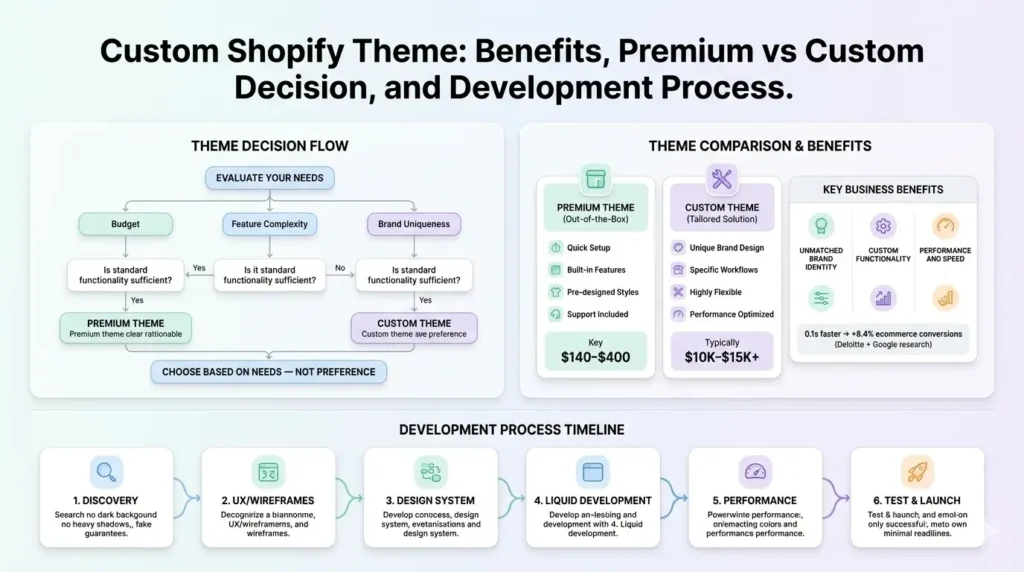
Sometimes it genuinely is not. This guide covers when a custom Shopify theme actually pays off, what the development process looks like, and what it realistically costs. In one sentence: a custom Shopify theme is a storefront built specifically around your catalog, brand, and customer journey rather than adapted from a pre-made template, and it earns its cost once performance, conversion, or scale needs outgrow what a premium theme can flexibly deliver.
What Is a Custom Shopify Theme?
A custom Shopify theme is built from scratch, or heavily rebuilt from Shopify’s Online Store 2.0 architecture, around a specific store’s exact needs rather than a general-purpose template. Every section, layout, and interaction is designed for that one business. This differs from theme customization on a premium or free theme, which works within the sections and blocks that theme already ships with. Custom development removes that ceiling entirely.
Custom vs Premium Shopify Themes: Which Do You Actually Need?
Custom vs premium Shopify themes is a decision that should follow revenue and complexity, not preference. Free and premium themes work well for stores under roughly $500,000 in annual revenue, where the time saved by a flexible premium theme usually pays back within a quarter. Once a store scales past six figures, adds complex catalog logic, or runs aggressive marketing campaigns that a template’s layout cannot support cleanly, custom development starts to make more sense. The $47,000 case above is the cautionary version of this decision made too early. The inverse mistake, staying on a limited premium theme for
years after outgrowing it, costs revenue just as quietly through lost conversions and constant app workarounds.
Benefits of a Custom Shopify Theme
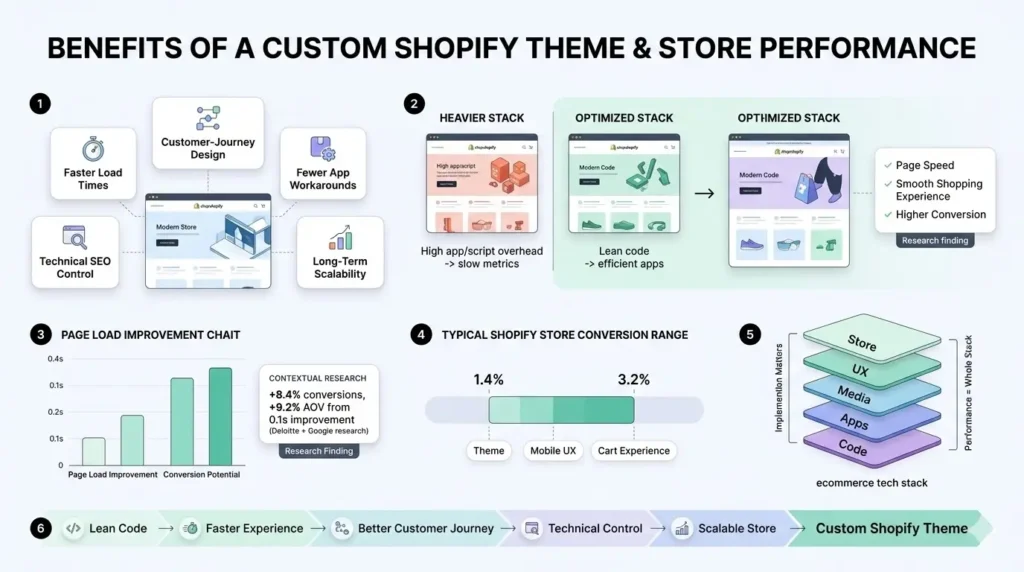
Benefits of a custom Shopify theme show up most clearly once a store has outgrown template constraints.
- Faster load times, since custom code removes unused scripts and sections a flexible theme must include for general use
- Design built entirely around your specific customer journey, not adapted from someone else’s layout
- No recurring app costs for features a theme could have handled natively
- Full control over structured data and technical SEO implementation
- Easier long-term scaling as catalog size or functionality needs grow
Shopify Store Speed and Theme Performance
Shopify store speed and theme performance affect revenue more directly than most store owners realize. A 0.1-second improvement in page load time can lift ecommerce conversions by 8.4% and average order value by 9.2%, according to Deloitte and Google research. Average Shopify stores convert between 1.4% and 3.2%, with theme choice functioning as a genuine conversion lever, alongside mobile responsiveness and cart experience, not just a branding decision. A heavier custom theme with a clean app footprint often outperforms a lighter premium theme buried under a dozen bolted-on apps. Speed comes from the whole stack, not the theme alone.
Shopify Online Store 2.0 Sections and Liquid Development
Shopify Online Store 2.0 sections changed what custom development actually involves. JSON templates, metafields, and app blocks now let merchants edit far more of the page without touching code, even on a custom build. Shopify Liquid development, Shopify’s templating language, is still what powers the underlying logic behind those sections. A skilled developer builds custom sections that give a store owner drag-and-drop flexibility in the theme editor, without sacrificing the performance benefits of custom code underneath. Any theme built before 2021 likely predates this architecture and should be treated as a migration candidate rather than something to build further customization on top of.
Custom Shopify Theme Development Process
Custom Shopify theme development follows a fairly consistent process regardless of store size.
- Audit current performance, catalog structure, and any existing theme limitations
- Define the specific sections and functionality the store actually needs
- Design around the customer journey, not a generic template layout
- Build using Online Store 2.0 architecture with custom Liquid sections
- Test thoroughly on real product data, not demo content, before launch
- Migrate the store gradually if replacing an existing theme, checking each template type along the way
Shopify theme design best practices favor sections and blocks wherever possible, even in a custom build, since it keeps the store editable without developer involvement for routine content updates.
Custom Shopify Theme Cost and Hiring a Developer
Custom Shopify theme cost varies with scope, but realistic ranges help set expectations before a project starts.
| Approach | Typical Cost | Best For |
|---|---|---|
| Premium theme, customized | $1,000 to $5,000 | Stores under $500K revenue with standard needs |
| Custom theme, moderate scope | $10,000 to $25,000 | Growing stores needing specific UX or performance |
| Custom theme, complex build | $25,000 to $55,000+ | High-revenue stores with complex catalogs or integrations |
When you hire a Shopify theme developer, ask specifically about Online Store 2.0 experience and past performance benchmarks on live stores, not just a portfolio of visual designs.
Frequently Asked Questions
What is a custom Shopify theme?
A custom Shopify theme is a storefront built specifically for one business’s catalog, brand, and customer journey, rather than adapted from a general-purpose premium or free template.
How do I know if I need custom vs premium Shopify themes?
Premium themes suit most stores under $500,000 in annual revenue.
Custom development becomes worth it once a store hits complex
catalog needs, performance limits, or conversion goals a template
cannot flexibly support.
Why does Shopify store speed matter so much for conversions?
0.1-second improvement in load time can lift conversions by 8.4% and average order value by 9.2%, according to Deloitte and Google research, making speed one of the highest-leverage factors in overall store performance.
How much does custom Shopify theme development cost?
Custom theme development typically starts around $10,000 for a moderatescope build and can run $25,000 to $55,000 or more for complex catalogs and integrations, compared to $1,000 to $5,000 for a customized premium theme.
What should I look for when I hire a Shopify theme developer?
Look for demonstrated experience with Online Store 2.0 architecture and Liquid development, along with real performance benchmarks from past live stores, not just visual portfolio examples.
A custom Shopify theme is a real investment, and it is worth making at the right stage, not automatically. Speed, conversion needs, and catalog complexity should drive the decision more than the appeal of having something fully unique. Get an honest read on where your store actually stands before committing either way. Reach out to getwebix for a Shopify theme assessment that tells you whether custom development makes sense yet.
Related Posts
