

Best CMS 2026: Why WordPress Still Wins
Key Takeaways
- WordPress powers roughly 42 to 43 percent of all websites and about 60 percent of the CMS market, more than every other platform combined.
- Over 60,000 free plugins and 30,000 themes mean most business features already exist, no custom development required.
- WordPress gives small businesses full ownership of their content, unlike closed website builders that lock you into their platform.
- WooCommerce, WordPress’s e-commerce plugin, processes tens of billions of dollars in sales each year across millions of stores.
- The main trade-off is setup responsibility. WordPress needs a bit more initial configuration than a drag-and-drop builder.
In one sentence: WordPress remains the best CMS 2026 has to offer for small businesses because it combines low cost, full content ownership, and stronger SEO control than closed platforms like Wix or Squarespace.
Best CMS 2026: Why WordPress Still Leads the Pack
I’ve watched clients try nearly every website platform on the market, and the same pattern shows up every time. Businesses that start on a closed builder eventually outgrow it and migrate to WordPress anyway. That’s not an accident.
When business owners search for the best CMS 2026 has to offer, they usually expect a fresh challenger to have taken WordPress’s spot. It hasn’t. WordPress still powers more websites than every other platform on the market combined, and for small businesses in the US, it remains the most practical starting point. This article breaks down exactly why, with real numbers, not just opinion.
WordPress Best CMS Numbers You Should Know
The market share data alone makes the case. WordPress powers between 42 and 43 percent of all websites globally, according to W3Techs tracking of the top 10 million sites. Among websites that use any CMS at all, WordPress holds close to 60 percent of that market, roughly nine times larger than its closest competitor.
That scale matters for a practical reason. A bigger user base means a bigger talent pool of developers, a bigger library of plugins, and faster fixes when something breaks. You are never stuck waiting on one company’s support queue.
- 60,000+ free plugins in the official directory
- 30,000+ themes covering nearly every industry
- Millions of active developers building extensions and fixes daily
- WooCommerce alone processes an estimated $35 billion in annual sales
Top WordPress CMS Benefits for Small Businesses
Market share explains popularity, but it doesn’t explain fit. Here’s what actually matters for a small or service-based business choosing a platform in 2026.
You Own Your Content, Not the Platform
Closed builders like Wix and Squarespace host your site on their servers, under their rules. If they raise prices or change policies, you have limited options. WordPress is self-hosted and open-source, so you control the hosting, the backups, and the exit plan.
The Cost Stays Predictable
WordPress itself is free. You pay for hosting, a domain, and any premium plugins you choose to add. Most small businesses run a full site for $100 to $500 a year in software costs, well below the recurring subscription fees many builders charge. [LINK: website cost breakdown guide]
It Scales With You
A five-page brochure site and a 500-product online store can both run on WordPress. Businesses rarely need to rebuild from scratch as they grow, they simply add plugins or custom functionality. Wix and Squarespace, by contrast, often hit a ceiling once a business needs advanced logic or custom integrations.
The Plugin Ecosystem Covers Almost Everything
Need a booking calendar, a membership area, an email signup form, or multilingual support? A plugin almost certainly exists already. This cuts development time and cost dramatically compared to building custom features on a closed platform.
Is WordPress the Best CMS for SEO?
For most small businesses, yes, and this is where WordPress separates itself most clearly from closed builders.
- Full control over technical SEO – title tags, meta descriptions, schema markup, and URL structure are all editable without developer help.
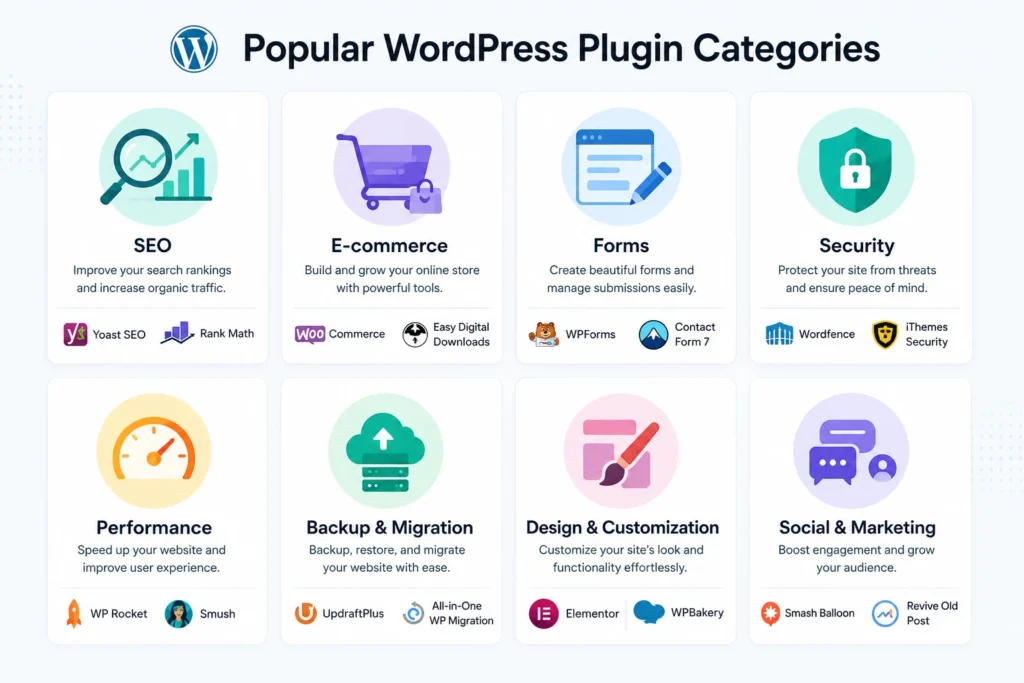
- Plugin-level SEO tools – Yoast SEO and Rank Math both offer free versions with built-in content scoring and sitemap generation.
- Faster content publishing – blog posts, service pages, and location pages can go live in minutes, which matters for local SEO.
- Clean, crawlable code – WordPress’s core architecture is well understood by search engines after two decades of widespread use.
Closed builders have improved their SEO tools significantly, but they still limit how deep you can go. Site speed and code-level customization on platforms like Wix are handled entirely by the platform, not by you.
WordPress vs Other Platforms: A Quick Comparison
| Platform | Best For | SEO Control | Ownership | Typical Cost |
|---|---|---|---|---|
| WordPress | Growing businesses, content-heavy sites | Full control, plugin-based | You own everything | $100 to $500/year |
| Wix | Simple sites, fast setup | Moderate, built-in tools | Platform-hosted | $16 to $60/month |
| Squarespace | Design-focused portfolios | Moderate | Platform-hosted | $16 to $65/month |
| Shopify | Dedicated online stores | Good for product SEO | Platform-hosted | $29 to $299/month |
| Webflow | Custom design, no-code visual builds | Strong, but less plugin depth | Platform-hosted | $18 to $49/month |
The pattern is consistent. Closed platforms trade long-term flexibility for short-term simplicity. WordPress asks for a bit more setup effort upfront in exchange for control you keep for the life of the business.
Where WordPress Falls Short
An honest recommendation includes the trade-offs. WordPress is not the right fit for every business, and it has real weaknesses worth naming.
- Setup takes longer than a drag-and-drop builder, especially for first-time site owners
- Security depends on you – most vulnerabilities come from outdated plugins and themes, not WordPress core itself
- Performance needs attention – a poorly optimized WordPress site can load slower than a builder-hosted alternative
- Plugin quality varies – not every plugin is well maintained, so vetting matters before you install one
None of these are dealbreakers, but they do mean WordPress works best when someone, whether that’s you, a freelancer, or an agency, takes ongoing ownership of updates and security. WordPress maintenance services
Frequently Asked Questions
What is the best CMS 2026 has to offer for a small business?
WordPress remains the best CMS 2026 has to offer for most small businesses. It combines low software cost, full content ownership, and stronger long-term SEO control than closed platforms like Wix or Squarespace.
How to know if WordPress is the right CMS for my business?
WordPress fits well if you plan to publish regular content, need e-commerce flexibility, or expect your site to grow in complexity. If you need a simple five-page site and never plan to expand it, a drag-and-drop builder may be faster to launch.
Why does WordPress still lead the CMS market despite newer competitors?
WordPress leads because of its scale advantage. A larger user base supports a bigger plugin ecosystem, more available developers, and faster security patches than any single competing platform can match on its own.
How to improve SEO on a WordPress website?
Install a dedicated SEO plugin like Yoast or Rank Math, optimize page titles and meta descriptions, compress images before uploading, and choose a lightweight, well-coded theme to keep load times fast.
What are the main WordPress CMS benefits over Shopify or Wix?
WordPress offers full content ownership, lower long-term software costs, and deeper customization through plugins. Shopify and Wix trade some of that flexibility for a simpler, more guided setup process.
The best CMS 2026 offers isn’t the newest one, it’s the one that gives your business room to grow without locking you into someone else’s platform. WordPress earns that spot through scale, flexibility, and a plugin ecosystem no competitor has matched.
If you’re ready to build a WordPress site that actually supports your growth instead of limiting it, and get a plan built around your business, not a template.
Related Posts
Local SEO for Service Businesses: Full Guide
Local SEO for Service Businesses: Full Guide Key Takeaways 46% of all Google searches carry local intent, and...
Read More
webshop
October 23, 2026
SSL Certificate and HTTPS: Why They Matter
SSL Certificate and HTTPS: Why They Matter Key Takeaways Starting with Chrome 154 in October 2026, Chrome will...
Read More
webshop
October 21, 2026
Shopify Migration: From WooCommerce or BigCommerce
Shopify Migration: From WooCommerce or BigCommerce Key Takeaways Most WooCommerce stores accumulate 20 to 60 active plugins by the...
Read More
webshop
October 19, 2026