


Automated Content Generation: A Small Business Guide
Key Takeaways
Automated content generation uses AI to draft blog posts, product descriptions, and marketing copy in minutes instead of hours.
55% of small businesses already use AI for content creation, and it’s now the second most common AI use case behind data analysis.
AI-written product descriptions have lifted ecommerce conversion rates by up to 23.7% in controlled studies.
Editing matters more than volume. Sites publishing lightly-edited AI content have seen major traffic gains, while unedited mass output has backfired.
The winning formula for small businesses is AI for the first draft, a human for the final polish.
Introduction
Here’s something most small business owners don’t expect: the businesses winning at content right now aren’t necessarily writing more by hand. They’re using automated content generation to produce a first draft in minutes, then spending their limited time on the parts that actually need a human touch, like brand voice and customer trust.
If you run a service business, an online store, or a new startup, you already know the problem. You need blog posts for SEO, product descriptions for every SKU, and social captions on top of it all. There simply aren’t enough hours in the week.
That’s exactly the gap automated content generation is built to close. By the end of this guide, you’ll know what it actually does, how it compares to hiring writers, and how to use it without producing the kind of generic content that hurts your search rankings instead of helping them.
In one sentence: automated content generation is the use of AI tools to draft blog posts, product descriptions, and marketing copy automatically, based on prompts, product data, or brand guidelines, so small businesses can publish more content in less time.
What Is Automated Content Generation?
Automated content generation is the process of using AI software, usually a large language model, to write text with minimal manual input. You give it a topic, product details, or a style guide, and it produces a draft.
It’s not new anymore. It’s become standard operating procedure. Recent research shows 58% of small businesses now use at least one AI tool, up sharply from around 36% just a few years ago, and content creation is consistently one of the top three use cases owners report.
For small businesses, this usually shows up in three places:
- Automated blog writing — drafting articles, how-to guides, and landing page copy for SEO.
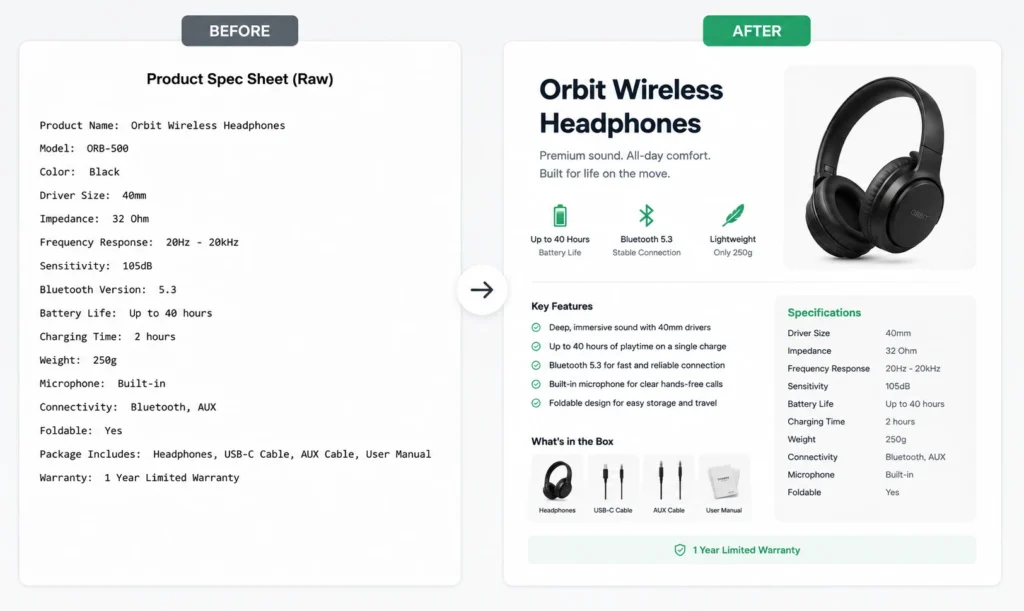
- AI product description generator tools — turning a spec sheet into persuasive, unique copy for each product.
- Content generation at scale — producing dozens or hundreds of pieces (social captions, email copy, listing variants) without hiring a full content team.
Why Small Businesses Are Adopting It Now
The Cost of Manual Content Doesn’t Scale
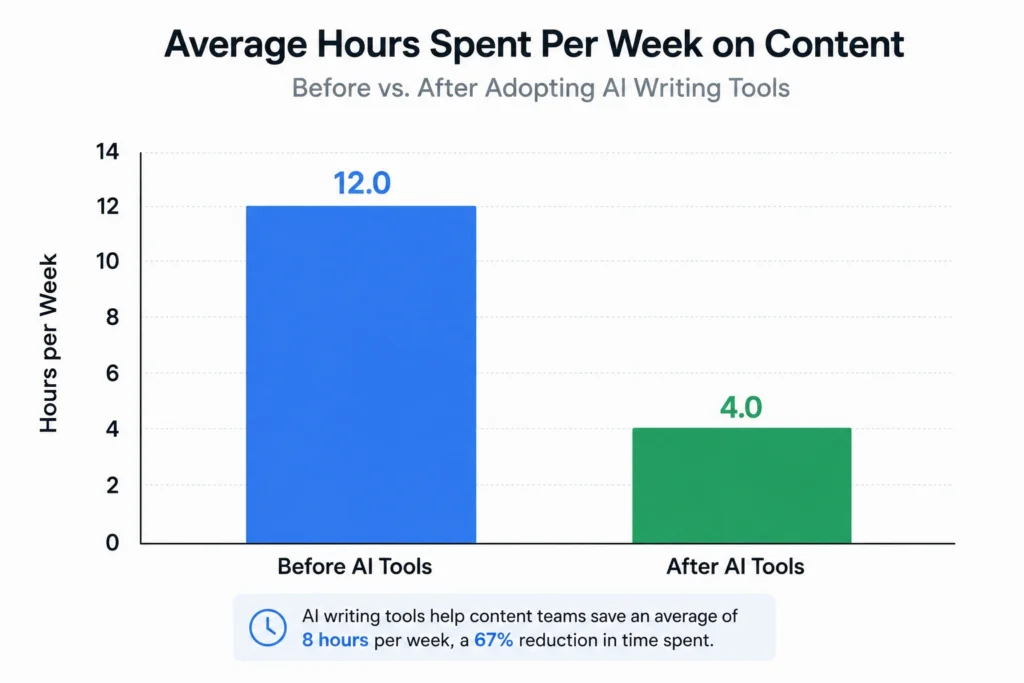
Hiring a full-time content writer or agency is expensive, and most small businesses can’t justify that spend for a blog that posts twice a month. Automated content generation flips that math. A subscription-based AI writing tool typically costs a fraction of a single freelance article, which is a big reason marketing has become the fastest-growing use case for AI among small firms.
It Solves the Product Description Bottleneck
If you sell 50, 500, or 5,000 products, writing a unique, SEO-friendly description for each one by hand is close to impossible. This is where an AI product description generator earns its keep.
A widely cited controlled study by European retailer Migros, working with researchers to test ChatGPT-generated product copy, found conversion rates rose by up to 23.7% when AI-written descriptions replaced generic ones. Better, more specific product information simply sells better.
Content Generation at Scale Is the Real Advantage
The biggest shift isn’t that AI can write one blog post. It’s that it can support content generation at scale, meaning consistent output across blogs, product pages, and email, without a proportional increase in headcount or hours.
Automated Blog Writing vs. Traditional Writing: A Quick Comparison
| Factor | Traditional Writing | Automated Blog Writing (AI) |
|---|---|---|
| Speed | Days per article | Minutes for a first draft |
| Cost per Piece | High (freelancer/agency rates) | Low (subscription-based) |
| Consistency | Varies by writer availability | Consistent output on demand |
| SEO Structure | Manual keyword research needed | Can be prompted with target keywords |
| Brand Voice & Nuance | Naturally strong | Needs human editing to sound authentic |
| Ranking Performance (Unedited) | N/A | Weaker; rarely reaches top positions alone |
| Ranking Performance (Human-Edited) | Strong | Strong, comparable to manual writing |
That last row matters most. A 2026 Semrush analysis of roughly 42,000 blog pages found human-written content held the #1 Google position 80% of the time, while fully AI-written, unedited content reached #1 only 9% of the time. A separate six-month tracking study found sites publishing 50–100 well-edited AI articles saw traffic gains of 30–80%, while sites publishing over 1,000 unedited AI articles saw traffic drops of 40–90%.
The takeaway for small businesses isn’t “avoid AI.” It’s “don’t skip the editing step.”
How to Use Automated Content Generation Without Sounding Robotic
1. Start With a Clear Brief, Not a Blank Prompt
Give the AI your target keyword, audience, tone, and any facts you want included. Vague prompts produce vague, generic content that reads like everyone else’s.
2. Always Add a Human Editing Pass
Treat the AI draft as a first draft, not a final one. Read it out loud, cut repetitive phrasing, and add specific details only your business would know, like a real customer story or a local detail.
3. Feed It Real Product Data for Descriptions
The best AI product description generator results come from accurate inputs: materials, dimensions, use cases, and what makes the product different. Vague inputs produce vague outputs.
4. Don’t Publish at Volume Without Quality Control
It’s tempting to generate hundreds of pages overnight. Resist it. As the data above shows, quality and editing consistently outperform raw volume.
5. Match Content to Search Intent
Whether it’s a blog post or a product page, make sure the content actually answers what the searcher is looking for; that’s still the single biggest ranking factor, automation or not. our guide to keyword research for small business blogs
Where Small Businesses Are Using It Today
- Service businesses use automated blog writing for how-to guides, FAQ pages, and local SEO content that answers common customer questions.
- Ecommerce startups use an AI product description generator to launch full catalogs without hiring a copywriting team.
- New businesses with lean teams use content generation at scale to maintain a consistent posting schedule across blog and social without burning out the founder.
how automated content fits into a small business marketing budget
Small businesses using AI for marketing report meaningful results from it, and it’s increasingly treated as a standard part of the marketing stack rather than an experiment. setting up a content calendar for small business blogs
Frequently Asked Questions
What is automated content generation?
Automated content generation is the use of AI software to write blog posts, product descriptions, or marketing copy automatically based on a prompt, keyword, or product data, reducing the time needed to produce a first draft.
How does an AI product description generator work?
It takes structured input, like product name, materials, dimensions, and features, and turns that data into readable, persuasive copy, often optimized for SEO keywords and formatted for the platform you’re selling on.
How do I start automated blog writing for my small business?
Start with a clear content brief that includes your target keyword, audience, and tone. Generate a draft, then edit it for accuracy, brand voice, and specific details before publishing.
Why does content generation at scale matter for small businesses?
It matters because small teams can’t manually write hundreds of product pages or a steady stream of blog content. Automation lets a small business maintain consistent output without hiring a full content team.
Is AI-generated content bad for SEO?
Not inherently. Research shows unedited, mass-produced AI content tends to underperform, while human-edited AI content can rank just as well as traditionally written content. The editing step is what separates the two outcomes.
Conclusion
Automated content generation isn’t about replacing your voice, it’s about giving small businesses and startups the ability to publish consistently without needing a full in-house content team. Used well, with real product data, clear briefs, and a human editing pass, it can shorten your content timeline from days to minutes while still ranking and converting.
If you’re a small business trying to keep up with blog content, product descriptions, or both, the tools exist today to close that gap and start publishing content that scales with your business instead of holding it back.
Related Posts
Local SEO for Service Businesses: Full Guide
Local SEO for Service Businesses: Full Guide Key Takeaways 46% of all Google searches carry local intent, and...
Read More
webshop
October 23, 2026
SSL Certificate and HTTPS: Why They Matter
SSL Certificate and HTTPS: Why They Matter Key Takeaways Starting with Chrome 154 in October 2026, Chrome will...
Read More
webshop
October 21, 2026
Shopify Migration: From WooCommerce or BigCommerce
Shopify Migration: From WooCommerce or BigCommerce Key Takeaways Most WooCommerce stores accumulate 20 to 60 active plugins by the...
Read More
webshop
October 19, 2026