


Shopify Development Agency: 10 Questions to Ask
Key Takeaways
- Over 8.5 million active stores now run on Shopify, so agency demand and pricing vary widely by experience level.
- Agency rates in the US typically run $75 to $200 per hour, well above freelancer rates of $25 to $80.
- Shopify Partner status is the baseline. Shopify Expert status means a vetted, higher-trust marketplace professional.
- The biggest red flag is an agency that shows screenshots instead of live, named client stores.
- A named point of contact and clear post-launch support terms matter more than the lowest quoted price.
In one sentence: the right Shopify development agency is the one that can show live stores they built, name who will work on your project, and explain their pricing and support terms before you sign anything.
Choosing a Shopify Development Agency: Why the Questions Matter More Than the Pitch
I’ve reviewed enough agency proposals to notice a pattern. The agencies with the best sales decks are not always the ones that deliver the best stores. The ones that answer hard questions directly, without dodging, usually are.
Choosing a Shopify development agency is one of the highest-stakes decisions a growing business makes online. Your storefront is where visitors decide whether to trust you with their money. Ask the wrong questions, or skip them entirely, and you risk a slow launch, a broken checkout, or a bill that keeps climbing. This guide gives you 10 direct questions to ask before you hire, plus what a strong answer actually sounds like.
How to Choose a Shopify Developer: The Market Context First
Before the questions, it helps to understand what you’re shopping for. Shopify now powers over 8.5 million active online stores worldwide, more than double the count from three years ago. That growth has pulled in agencies of wildly different quality, from single freelancers to enterprise-grade Shopify Plus partners.
US-based agencies typically bill $75 to $200 per hour, while freelance developers often charge $25 to $80. That gap isn’t random. Agencies usually bundle project management, quality assurance, and structured delivery into the rate, which reduces risk on larger builds. Knowing this range before you start calls keeps you from either overpaying or dismissing a fair quote.
10 Questions to Ask Before You Hire a Shopify Agency
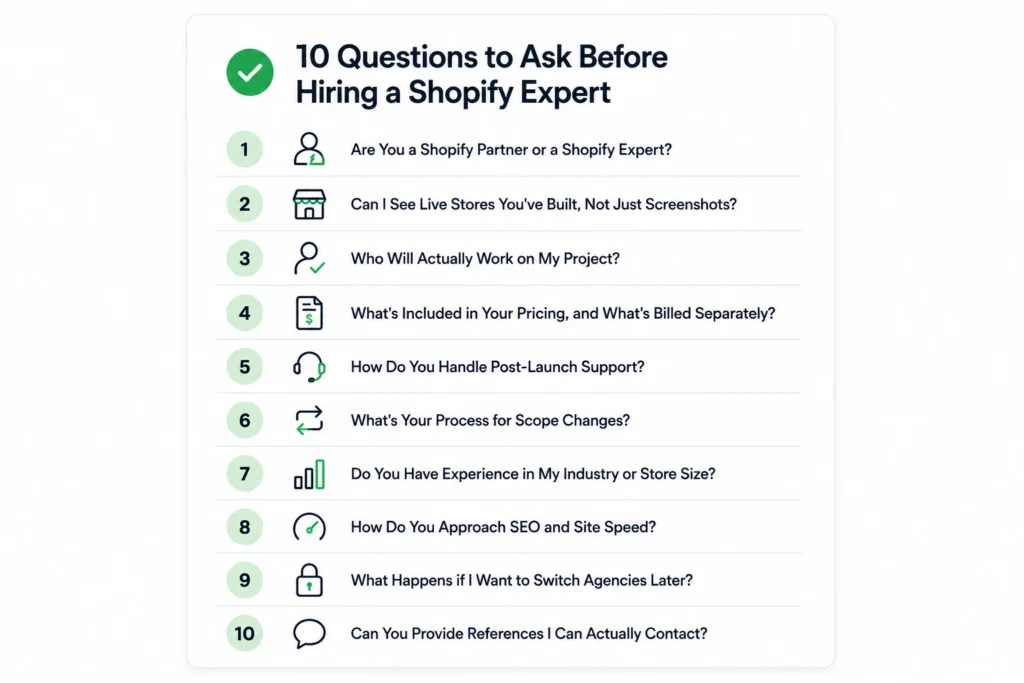
1. Are You a Shopify Partner or a Shopify Expert?
Anyone can join Shopify’s Partner Program with minimal barriers to entry. Shopify Expert status means the agency has passed a vetting process and demonstrated advanced proficiency. Experts typically cost more, but the trust difference is real, especially for a first-time hire.
2. Can I See Live Stores You've Built, Not Just Screenshots?
Ask for links to real, currently active stores with named clients. Screenshots and anonymized case studies are a common red flag. A confident Shopify development partner will happily point you to work you can visit right now.
3. Who Will Actually Work on My Project?
Some agencies sell you on a senior team during the pitch, then hand your build to junior staff or subcontractors. Ask for the specific names and roles of the people doing the work, not just the account manager you’re speaking with.
4. What's Included in Your Pricing, and What's Billed Separately?
A quote that only covers design and development can leave you surprised by app costs, theme licenses, or a Shopify Plus subscription later. Ask for a full breakdown before you commit. [LINK: Shopify development cost guide]
5. How Do You Handle Post-Launch Support?
A launch date isn’t the finish line. Ask what happens the week after your store goes live, how bugs get fixed, and whether ongoing maintenance is included or billed as a separate retainer, typically $200 to $500 a month.
6. What's Your Process for Scope Changes?
Projects evolve. Ask how the agency handles a mid-project request, whether it triggers a change order, and how pricing adjusts. Agencies without a clear answer here often produce the most disputed final invoices.
7. Do You Have Experience in My Industry or Store Size?
A Shopify Plus specialist built for enterprise multi-region builds may be the wrong fit, and the wrong price, for a small business launching its first store. Ask for examples close to your size and category.
8. How Do You Approach SEO and Site Speed?
Site speed and structured data directly affect Google rankings and conversion rates. Ask whether SEO and Core Web Vitals are built into the development process or treated as an optional add-on you’ll need to request separately.
9. What Happens if I Want to Switch Agencies Later?
Ask who owns the code, the theme files, and the store setup once the project ends. A trustworthy Shopify development partner hands over full access without resistance if the relationship ends.
10. Can You Provide References I Can Actually Contact?
A short list of past clients willing to answer a phone call tells you more than any portfolio page. If an agency hesitates here, treat that hesitation as useful information.
Shopify Partner vs Expert vs Freelancer vs Agency
Not every hiring path fits every business. Here’s how the main options compare.
If you’re a small business launching your first store, a vetted Shopify Partner or Expert agency is usually the sweet spot between cost and reliability. Save Plus-level partners for once your revenue and complexity actually require them. Shopify store setup services
Red Flags to Watch For When You Hire a Shopify Agency
A few warning signs show up again and again in agencies that underdeliver:
- Vague answers about who will actually do the work
- No live, named case studies you can visit
- Pricing that excludes apps, themes, or the Shopify subscription itself
- No clear post-launch support plan
- Reluctance to provide client references
None of these alone is disqualifying, but two or more together is worth pausing over before you sign a contract.
Frequently Asked Questions
What is a Shopify development agency?
A Shopify development agency is a team that builds, customizes, and maintains Shopify stores for merchants, handling everything from theme design to app integrations, payment setup, and ongoing technical support.
How to hire a Shopify agency without overpaying?
Get quotes from at least three agencies, ask for a full cost breakdown that includes apps and platform fees, and compare experience level to your actual store size rather than choosing the cheapest or most expensive option by default.
Why does Shopify Partner status matter when choosing a developer?
Partner status confirms the agency has an active relationship with Shopify and access to platform resources. Expert status goes further, requiring a vetting process that verifies demonstrated skill, which adds a layer of trust for first-time hires.
How to know if a Shopify development partner is a good fit for my business?
Look for live case studies close to your industry and revenue size, a named point of contact, and a clear answer on post-launch support. A good fit shows evidence, not just promises.
What should I budget to hire a Shopify agency for a small business store?
Most US small businesses building a professional first or second store should budget $2,000 to $8,000 for one-time development, plus $40 to $150 a month in ongoing platform and app costs.
The right Shopify development agency earns your trust with evidence, not promises. Ask these 10 questions before you sign anything, and treat vague or defensive answers as your clearest signal to keep looking.
Ready to talk through your project with a team that answers these questions directly? And get a clear, honest scope before you commit to anything.
Related Posts

Website Cost in 2026: What Small Businesses Really Pay
Website Cost in 2026: What Small Businesses Really Pay Key Takeaways DIY builders cost $200–$800 in the first...
Read More
webshop
July 14, 2026