

Hidden Costs of Website Development to Watch
Key Takeaways
- Scope creep affects roughly half to 70% of software and web projects, adding an average cost overrun of around 27%.
- One analysis of web project budgets found small business sites commonly finish 52% over their original quoted price once midproject additions are counted.
- Domain renewal fees are a classic hidden cost. A domain priced at $1 to $5 for the first year often renews at $30 to $45 or more annually.
- Hosting, plugins, third-party integrations, and maintenance rarely appear in a headline build price, but they add up fast after launch.
- A detailed, itemized quote before work starts is the single best protection against hidden costs of website development.
Hidden Costs of Website Development to Watch
A website quote rarely tells the whole story. Hidden costs of website development, scope creep, renewal fees, plugin licenses, and ongoing maintenance, routinely turn a clean upfront number into something much bigger by the time the site actually launches. We have reviewed plenty of quotes from other agencies that looked great on paper, until the client discovered hosting, premium plugins, and “minor” scope additions were never actually included. This guide breaks down exactly where those hidden costs usually hide, so you can budget for the real number, not just the headline one. In one sentence: hidden costs of website development typically come from scope creep during the build, ongoing expenses like hosting and plugin licenses left out of the initial quote, and renewal fees that jump sharply after an introductory first-year price.
Website Development Cost: What the Quote
Usually Doesn’t Show Website development cost figures get thrown around constantly, but how much does a website cost really depends on what the quoted number does and does not include. A website development quote breakdown should separate design,
development, content, and any third-party tools clearly, line by line. Vague, bundled quotes are exactly where hidden costs tend to creep in later, since it is unclear what was actually priced in versus assumed. Ask specifically what is excluded, not just what is included. That single question surfaces most hidden costs before a contract is signed.
Scope Creep in Web Development: The Biggest Hidden Cost
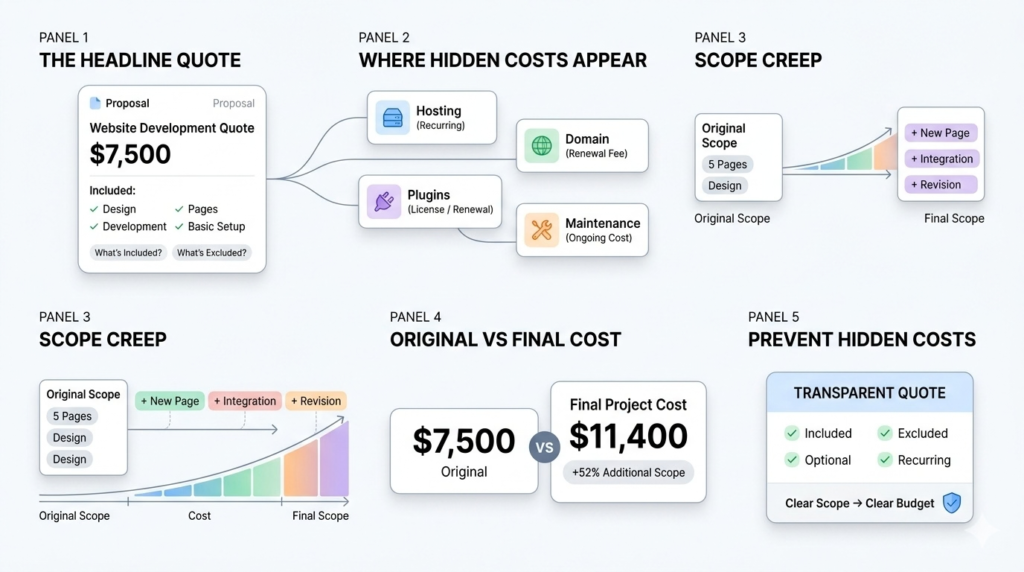
Scope creep in web development is the single largest source of budget overruns on most projects. Industry research puts the share of projects affected at roughly half to 70%, with an average cost overrun attributable to scope creep of around 27%.
It rarely shows up as one dramatic change. It looks like a new page added after the wireframes were approved, an integration nobody scoped from the start, or a design revision round that goes beyond what was agreed. One analysis of small business web project budgets found sites with an original quote around $7,500 commonly finished closer to $11,400, a 52% overrun, almost entirely from additions made mid-project rather than the original scope.
Ongoing Website Costs for Small Business
Ongoing website costsfor small business rarely make it into the initial conversation, but they start the moment the site launches.
| Ongoing Cost | Typical Annual Range | Notes |
|---|---|---|
| Website hosting costs | $100 to $1,000+ | Varies heavily by traffic and hosting type |
| Website maintenance costs | $600 to $3,600 | Updates, backups, security monitoring |
| Domain renewal | $15 to $50+ | Often jumps sharply after year one |
| SSL certificate | $0 to $400 | Free options usually sufficient for small sites |
Domain Renewal Fees: The Classic Bait and Switch
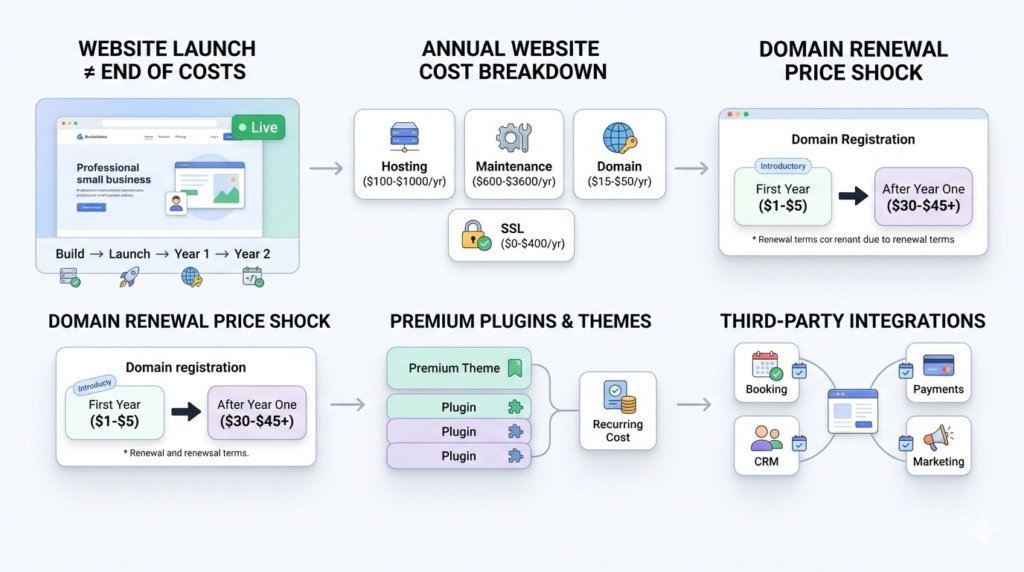
Domain renewal fees catch more business owners off guard than almost any other line item. A domain advertised at $1 to $5 for the first year frequently renews at $30 to $45 or more annually, a jump that can exceed 600% without ever being flagged upfront.
Check the actual renewal price before registering, not just the promotional first-year rate. Most registrars display it, just not
prominently.
Premium Plugins, Themes, and Third-Party Integrations
Premium plugin and theme costs add up quickly on WordPress and similar platforms. A single premium theme might run $60 to $200 as a one-time cost, but many plugins charge annual licensing fees of $50 to $300 each, and most functional sites need several. Third-party integration costs compound this further. Booking systems, payment processors, CRM connections, and marketing tools frequently carry their own subscription fees layered on top of the website itself, separate from anything the web developer charges. Ask for a full list of required plugins and integrations before the build starts, along with their ongoing costs, not just their one-time setup fee.
Website Redesign Costs: Budgeting for the Next Round
Website redesign costs deserve a place in the original budget conversation too, even though they happen years later. Most small
business sites need a meaningful update every two to three years as design standards, content, and functionality needs shift.
Treating a website as a one-time expense rather than a recurring investment is exactly how businesses get blindsided by a redesign quote that feels unexpectedly large.
How to Budget for a Website Without Getting Blindsided
Learning how to budget for a website comes down to asking the right questions before signing anything.
- Request an itemized quote that separates design, development, content, and any add-ons
- Ask explicitly what ongoing costs, hosting, maintenance, plugins, are not included
- Get the actual renewal price for your domain, not just the promotional rate
- Build in a 15% to 25% buffer for reasonable scope additions during the project
- Budget for a redesign every two to three years as a recurring line item, not a surprise
Frequently Asked Questions
What are the most common hidden costs of website development?
The most common hidden costs are scope creep during the build,
domain renewal fees that jump after the first year, ongoing hosting and
maintenance, and premium plugin or integration subscriptions not
included in the original quote.
How much does a website cost when you include ongoing expenses?
Beyond the initial build, expect $700 to $4,000 or more per
year in hosting, maintenance, domain renewal, and plugin costs,
depending on site complexity and functionality.
Why does scope creep add so much to website development budgets?
Scope creep adds up through small, reasonable-seeming
additions rather than one big change. Industry data shows it affects most
software and web projects, with average cost overruns around 27%.
How do I avoid surprise costs when budgeting for a website?
Request a fully itemized quote, ask specifically what is excluded, confirm
actual domain renewal pricing, and build in a buffer for reasonable
scope changes before the project starts.
What should be included in a website development quote breakdown?
Hidden costs of website development are rarely malicious, they are
usually just left unstated until they show up on an invoice. Scope creep,
renewal fees, and ongoing subscriptions are predictable once you know
where to look.
Ask for the full picture upfront, and the number you agree to is the
number you actually pay. Reach out to getwebix for a transparent, fully
itemized website quote with no surprises after launch.
Conclusion
Hidden costs of website development are rarely malicious, they are usually just left unstated until they show up on an invoice. Scope creep, renewal fees, and ongoing subscriptions are predictable once you know where to look. Ask for the full picture upfront, and the number you agree to is the number you actually pay. Reach out to getwebix for a transparent, fully itemized website quote with no surprises after launch.
Related Posts

E-commerce Payment Gateway Integration Guide
E-commerce Payment Gateway Integration Guide Key Takeaways Nearly 70 percent of online shopping carts get abandoned before checkout,...
Read More
webshop
July 26, 2026

Best CMS 2026: Why WordPress Still Wins
Best CMS 2026: Why WordPress Still Wins Key Takeaways WordPress powers roughly 42 to 43 percent of all...
Read More
webshop
July 23, 2026